
A family friendly rental in Phoenix is one with enough room to spread out, a full kitchen and laundry, safe sleeping and play spaces, reliable cooling, and a location close to the things your kids will do. The label itself guarantees nothing. Listings use it loosely, so the work is in checking the details. This guide shows what to check, how to compare a vacation home, a monthly furnished rental and a flexible multi-month stay, and where Downtown and Roosevelt Row fit for families.
TL;DR
- “Family friendly” is a marketing phrase, not a standard. Verify smoke and carbon-monoxide alarms, pool barriers, window cords, furniture anchoring and sleeping arrangements yourself.
- Phoenix heat is part of the safety picture: confirm the cooling works, check which way the unit faces, and plan outdoor time around the hottest hours.
- Stays of 31 days or longer are treated differently from short-term rentals under Phoenix city code, which can change the paperwork and the terms you sign.
- Downtown and Roosevelt Row put museums, light rail and restaurants within reach, which suits families who want to leave the car parked.
- Our furnished lofts suit small families and longer stays, with full kitchens, in-unit laundry, WiFi and workspaces.
Table of Contents
- What “family friendly” should mean in Phoenix
- The safety checks that matter most
- Heat is a family issue in Phoenix
- Vacation home, monthly rental or flexible stay?
- Rules and paperwork that affect your stay
- Downtown and Roosevelt Row with kids
- Our view: what families actually need
- Furnished lofts in Downtown Phoenix for your family stay
- Pets, nurses and remote work: other things families ask
- A booking checklist you can use today
- FAQ
- Sources
What “family friendly” should mean in Phoenix
The top results for this search show how wide the label stretches. Some are four-bedroom vacation homes with a pool and a hot tub. Some are apartment communities. Others are resort pages. Each fits a different family, so start with your own situation before you scroll listings.
Ask these questions first:
- How long are you staying? A long weekend, a month and a winter are three different problems.
- How old are your children? A toddler needs different things than a teenager.
- Do you need a car? Phoenix is spread out, and some areas are far easier to cover on foot or by rail.
- Are you working while you stay? Relocating parents and remote workers need a real desk and dependable WiFi, not a kitchen stool.
- Do you have a pet? Fees and rules vary a lot between rentals.
The City of Phoenix describes its own housing communities as ranging from apartments to single-family homes, with one to five bedrooms, and lists kitchens, laundry, parking, playgrounds and pools at selected properties, near schools, grocery stores and transit. That list is a useful checklist even for a private rental: kitchen, laundry, parking and proximity to daily needs matter more to a family than a decorative extra.
The safety checks that matter most
You can do most of this in ten minutes on arrival, and some of it before you pay by asking the host or manager.
Alarms and basic equipment
The U.S. Consumer Product Safety Commission recommends that guests of a vacation rental verify working smoke alarms, carbon-monoxide alarms and at least one fire extinguisher, and take extra care where there is a pool or a residential elevator. Ask for this in writing before booking, and test the alarms when you walk in.
Pools and water
If the rental has a pool, spa or hot tub, the barrier is the first thing to look at. Phoenix requires barriers for pools, spas and hot tubs holding water 24 inches or deeper. The city’s rules call for a non-climbable fence or wall at least five feet high, self-closing and self-latching gates, latches at least 4.5 feet up or out of small children’s reach, and openings under four inches. Those requirements are written for the city’s housing inspections, but they give you a concrete yardstick for any pool. The city’s short-term rental paperwork also states that the rental address must comply with pool-barrier requirements.
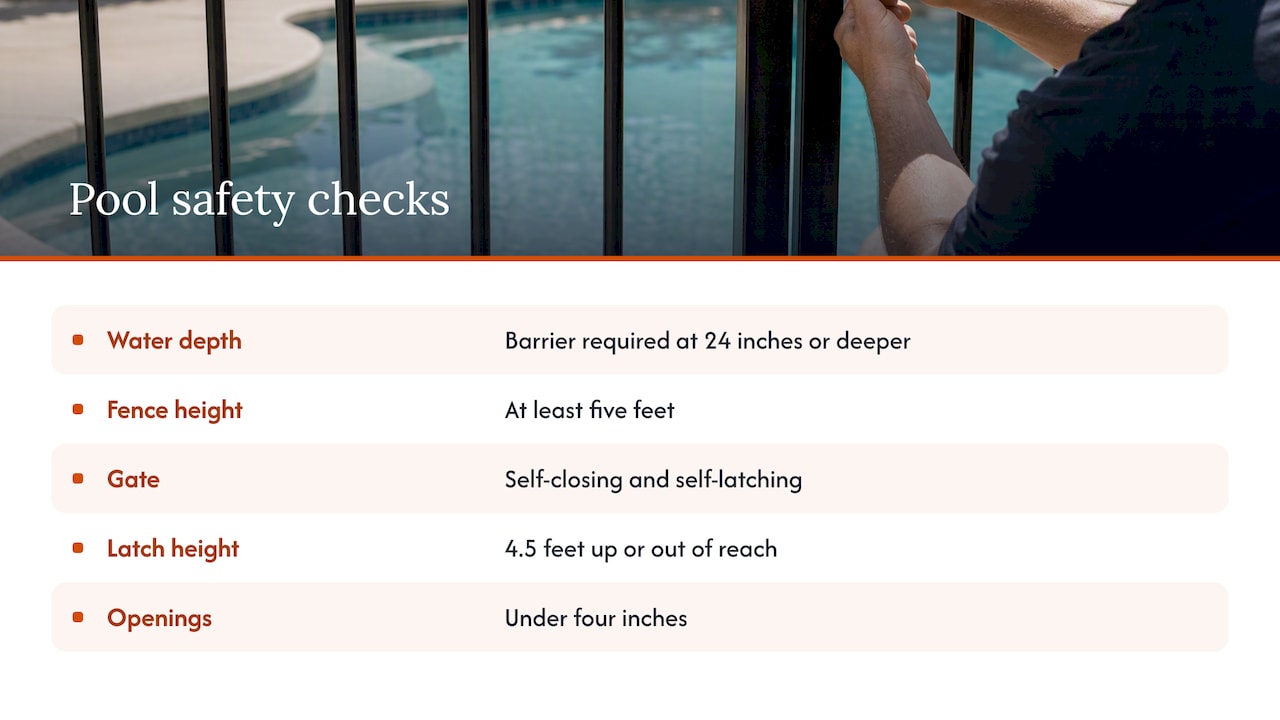
The CPSC also suggests layered protection around pools, such as self-latching gates, door alarms and safety covers. Barriers do not replace adult supervision. If you have a child under five, a building without a private pool removes one risk entirely.
Windows, furniture and sleeping
The same CPSC guidance recommends cordless window coverings or secured cords, window guards or stops, and anchored furniture and televisions. Higher floors and lofts with tall windows make window stops worth a question. For babies, the agency advises a crib with a firm, tight-fitting mattress and only a fitted sheet, and says to keep cleaning products and laundry packets in locked or child-latched cabinets. With in-unit laundry, that last point applies to you on day one: put the packets up high.
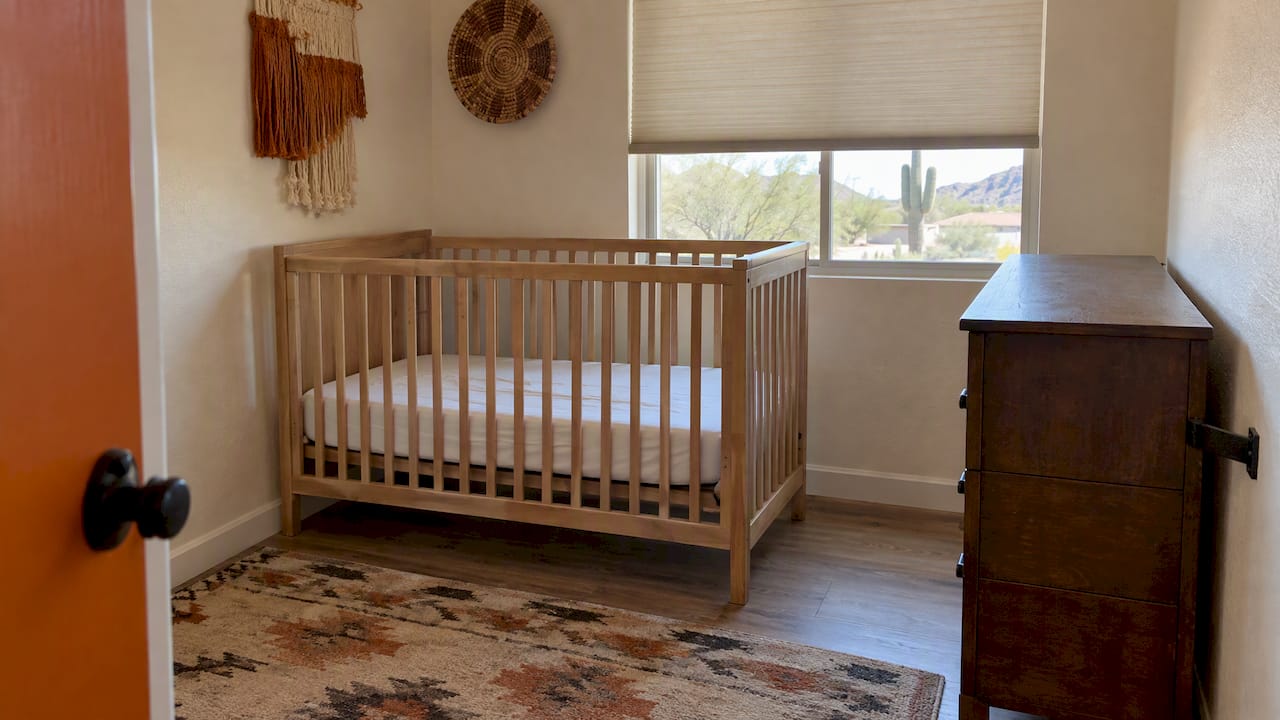
If you need a crib or high chair, ask whether the rental supplies one. If it does not, a portable play yard from home is often the simpler route.
Heat is a family issue in Phoenix
Summer in Phoenix changes how a rental should be judged. The National Weather Service says effective cooling and adequate hydration matter during heat risk, and infants and young children need more frequent monitoring. So check cooling the way you would check a crib.
- Ask what cools the unit and whether it covers every room. The city specifies that where cooling is installed, it must be able to cool every habitable room to 82 degrees for refrigerated air, or 86 degrees for evaporative coolers.
- Check the orientation. Advice for Phoenix renters notes that west-facing units get intense afternoon sun that can raise cooling costs. For a monthly stay, ask how utilities are billed.
- Plan the day around the sun. Mornings for outdoor play, midday for museums, evenings for walks. A rental near indoor attractions makes this easy.
In a winter stay, the problem flips: mornings and evenings can be cool, so ask about heating too. Arizona landlord rules call for reasonable heating and air conditioning where installed when the season requires it on longer leases.
Vacation home, monthly rental or flexible stay?
Families usually choose among three formats. Each trades space, price, paperwork and flexibility differently.
| Vacation home | Furnished monthly rental | Flexible multi-month stay | |
|---|---|---|---|
| Best for | A week or two, big groups | One to three months, relocation, medical or work assignments | Winter stays, house hunting, renovations |
| Space | Often 3+ bedrooms, yard, sometimes a pool | Studios to larger units | Studios to larger units |
| Kitchen and laundry | Usually yes | Should be full kitchen and in-unit laundry | Same |
| Rules to check | Pool barrier, occupancy limit, house rules | Lease terms, utilities, deposit | Renewal terms, pet terms, cancellation |
| Paperwork | Short-term rental rules | Often a lease | Often a lease |
A vacation home with a private pool gives kids a place to burn energy, but it also brings the pool risk and often a higher bill. A furnished monthly rental in a walkable area gives you a kitchen, laundry and a routine. For a stay of several weeks, in-unit laundry cuts luggage, and a full kitchen cuts restaurant spending with children who eat at odd hours.
If you are comparing a furnished unit against a hotel for a long stay, our guide on corporate housing versus hotels for long stays walks through the trade-offs, and the room by room amenities list shows what to demand in the inventory.
Rules and paperwork that affect your stay
Phoenix regulates short-term rentals, and the rules shape what you are booking. The city says it replaced its registration process with a mandatory limited permit, in effect since November 6, 2023, for all short-term rental properties. Under Phoenix City Code, a residential lease of 31 days or longer is not considered a vacation or short-term rental. That 31-day line is why a stay of a month or more usually comes with lease-style terms. We explain it further in our piece on the 30-day cutoff for mid-term rentals.
The same ordinance says owners or agents must respond to complaints at any time and be reachable within 60 minutes when police request it. As a guest, take that as a reason to ask who your contact is and how fast they reply. A good manager answers before you need the ordinance.
Two more practical points:
- Grilling. Many buildings and HOAs restrict it, so confirm whether patio or balcony grilling is allowed if a family cookout is part of the plan.
- Insurance and damage. Kids spill things. Read the damage and deposit terms, and look at how vacation rental insurance works for guests and owners so you know what a trip policy or your own coverage may handle.
Downtown and Roosevelt Row with kids
Downtown is not the first area that comes to mind for families, yet it works for the right ones: families with school-age children, relocating parents, or anyone who wants to skip the car.
Downtown’s own visitor organization lists family attractions including the Children’s Museum of Phoenix, the Arizona Science Center and the weekly Downtown Phoenix Farmers Market. Check each venue’s current hours and ticket prices on its own site before you go.
Roosevelt Row and Grand Avenue are walkable arts districts with galleries, murals and small businesses that grew out of grassroots revitalization in the 1990s. Murals are free entertainment for kids, and a walk in the cooler months doubles as a scavenger hunt. Roosevelt Row is reachable by Valley Metro light rail, so you can leave the car at the rental.
For arrivals by air, the PHX Sky Train is free, runs around the clock, links the terminals and Rental Car Center, and connects to the 44th Street light rail station. We cover the route in detail in our guide to getting to Downtown Phoenix on the Sky Train, and our page on lofts near light rail covers staying close to the stations. Traveling with strollers and car seats? Our airport and rideshare page is the place to plan it.
Be honest about the trade-off: Downtown is urban. You will not find a backyard or a private pool at a loft. If your children need a yard, a suburban vacation home fits better. If they enjoy museums, murals and trains, Downtown fits well.
Our view: what families actually need
We run furnished lofts and apartments in Downtown Phoenix, and families who stay with us for weeks tend to care about the same few things. They want a kitchen that works for real meals, a washer and dryer they do not share, a place for a parent to take a work call, and a pace that does not need a car for every errand. Those are the things we build our units around: fully equipped kitchens, in-unit laundry, workspaces and WiFi.
We also think families should ask more questions than they do. Ask for the bed setup in writing. Ask what the windows look like, how the unit is cooled, and who answers the phone at 9 p.m. A manager who gives clear answers before you book will give them after. Our pre-signing checklist is the list we would hand a friend, and it works for any rental, ours or not.
One more thing: lofts are open, stylish spaces, and that is a strength for couples and small families, but a family with a toddler should look at layout before style. Tour with the children’s routine in mind: where the crib goes, where the stairs and windows are, and how far the kitchen is from the sleeping area. Our loft versus apartment guide gives five tour questions to bring.
— Sean
Furnished lofts in Downtown Phoenix for your family stay
If your plan is a month or more, a relocation, a medical assignment, a renovation or a winter away, our furnished lofts are built for it. We offer fully furnished units in Downtown Phoenix, including Roosevelt Row, with full kitchens, in-unit laundry, workspaces and WiFi, pet-friendly options, and flexible booking. Prices vary by unit and dates, so see current availability on our properties page.
If a long stay is tied to home repairs, see our guide to temporary housing during a renovation. If you are comparing owning furniture to renting it furnished, our break-even breakdown shows the math.
Pets, nurses and remote work: other things families ask
Many families travel with a dog or have a parent on assignment. A few checks help:
- Pet terms. Ask about pet fees, deposits, weight or breed limits and the number of pets allowed, and get them in writing. Pets also affect the heat plan: pavement in Phoenix gets hot, so walks belong in early morning or evening.
- Hospital proximity. If a parent is a traveling nurse, distance to the hospital matters more than almost anything. Compare commute times at the hours of the shift, not at midday. See how we handle this near one hospital in our guide to housing near Abrazo Heart.
- Work setup. A dedicated desk, dependable WiFi and a door or a corner that gives quiet make a long stay work. Our page on monthly rentals with business amenities lists what to look for.
A booking checklist you can use today
Before you pay, get answers to these in writing:
- Bedroom and bed configuration, and how many people the unit sleeps.
- Working smoke and carbon-monoxide alarms and a fire extinguisher.
- Pool, spa or hot tub: yes or no, and the barrier description.
- Cooling type, and whether it covers every room.
- Crib, high chair or other baby gear: supplied or not.
- Laundry: in the unit or shared.
- Deposit, cleaning fees, pet fees, cancellation and renewal terms.
- Parking, or the nearest light rail station.
- Who to call after hours, and how quickly they respond.
On arrival, walk the unit with your phone: test alarms, look at window cords and stops, check that furniture and TVs are anchored, and photograph any damage so it is on record.
FAQ
What makes a Phoenix rental family friendly?
Space to sleep comfortably, a full kitchen, laundry, safe windows and furniture, working alarms, a compliant pool barrier if there is a pool, and cooling that reaches every room. Location counts too: nearby grocery stores, transit and things for kids to do. Verify each point yourself rather than relying on the listing label.
Is Downtown Phoenix a good area for families?
Yes, for families who value walkability and indoor attractions. The Children’s Museum of Phoenix, the Arizona Science Center and the farmers market are all Downtown, and light rail connects the area. It lacks the yards and private pools of suburban homes.
Is a furnished monthly rental better than a vacation home for a family?
It depends on the length and the group. For a week with a big group, a vacation home gives more room. For a month or more, a furnished rental with a full kitchen and in-unit laundry is usually simpler and easier to budget, and Phoenix treats leases of 31 days or longer differently from short-term rentals.
Can I bring my dog to a furnished rental in Phoenix?
Often yes, but terms vary by property. Confirm fees, deposits and size or breed limits before booking, and ask for them in writing. We offer pet-friendly options, so check our properties page for current units.
When is the best time to visit Phoenix with children?
The cooler months are the easiest for outdoor time, while summer calls for indoor plans and careful heat management. The National Weather Service advises effective cooling, hydration and closer monitoring of young children during heat risk.
Sources
- Housing Communities, City of Phoenix
- Make Safety a Priority When Staying in a Vacation Rental Home, CPSC
- Pool Policy, City of Phoenix
- Short-term rental affidavit and attestation, City of Phoenix
- Childproofing Your Home, CPSC
- Home Safe with Young Children, CPSC
- NWS Phoenix Heat Page
- Inspecting a Phoenix rental before and after you sign
- 5 essential questions to ask before renting in Phoenix, AZ
- Short-Term Rental Registry, City of Phoenix
- Phoenix Short Term Vacation Rental Ordinance
- Family Friendly Things To Do In Downtown Phoenix
- Roosevelt Row, Grand Avenue and Melrose, City of Phoenix
- Where to Stay in Phoenix with Kids
- The PHX Sky Train, Phoenix Sky Harbor
Leave a Reply