
A fully equipped kitchen includes a full-size range or oven, a refrigerator with a freezer, a sink with running water, and enough cookware, utensils, and tableware to prepare and clean up a complete meal. Most rentals add a microwave, coffee maker, and dishwasher, though those extras vary by property. High-end furnished homes stock more; budget kitchenettes stock less, and that gap is exactly what you need to check before you book.
TL;DR:
- Most fully equipped kitchens include a full-size range or oven, a refrigerator with a functioning freezer, and a sink with hot water, allowing complete meal preparation from raw ingredients.
- Essential appliances such as a dishwasher are common but not universal, especially in older or smaller units, while kitchen size often dictates whether it meets full or kitchenette standards.
- Listings that specify items like stove type, fridge size, or include detailed inventories reduce guest confusion and help travelers verify they will have the necessary tools for their cooking needs.
- A kitchenette, typically under 80 square feet, usually offers a microwave, small fridge, and minimal cooking equipment without a full oven or extensive storage capacity.
- Proper maintenance involves hosts or property owners handling repairs and restocking essentials, with responsibility eventually shifting to renters or homeowners for ongoing upkeep.
Table of Contents
- What Makes a Kitchen “Fully Equipped,” Not Just Furnished
- What’s Actually in the Cabinets: Cookware, Dishes, and Small Appliances
- Fully Equipped vs. Fully Stocked vs. Kitchenette: The Terms Renters Confuse
- Your 12-Point Checklist Before You Book or List a Kitchen
- How One Phoenix Rental Provider Handles Kitchen Inventory
- Kitchen Standards Shift by Region and Building Type
- Why the Kitchen Matters Differently Depending on Who You Are
- Who Keeps the Kitchen Running: Maintenance and Upkeep
- How the Same Standard Looks Across Apartments, Hotels, and Vacation Rentals
- What I’d Actually Prioritize When Booking a Kitchen
- See What a Fully Equipped Kitchen Looks Like in a Phoenix Rental
- Sources
- FAQ
What Makes a Kitchen “Fully Equipped,” Not Just Furnished
The core test is simple: could you cook a real meal from raw ingredients and clean up afterward without buying a single tool? If the answer is yes, the kitchen clears the bar. If you’d need to run to a store for a pan or a can opener, it doesn’t, no matter what the listing calls it.
Three appliances form the non-negotiable base. A full-size range or oven lets you roast, bake, or simmer, not just reheat leftovers in thirty-second bursts. A refrigerator with a functioning freezer gives you real food storage, which matters more than most travelers expect until they’re stuck with warm milk on day two. A sink with hot and running water handles washing produce, filling pots, and cleaning dishes, and its absence turns a kitchen into a display shelf.
A dishwasher is typical in many fully equipped kitchens but isn’t universal, especially in older buildings or smaller units where plumbing and space run tight. Dictionary and design references describe a properly fully fitted kitchen as one built around units and essential appliances like an oven and dishwasher, which lines up with what most renters actually expect when they see the phrase in a listing.
Range type changes the experience more than people realize. Gas ranges heat fast and give you visual flame control, which serious cooks tend to prefer. Electric coil or radiant ranges are common in older buildings and heat more slowly. Induction ranges heat fastest of all but only work with magnetic cookware, so if you’re bringing your own pots, check compatibility first.
Here’s what’s missing from a kitchen that isn’t fully equipped, and why it matters:
- No oven: you can’t roast a chicken, bake, or make anything requiring dry heat above a stovetop flame.
- No full-size fridge: you’re buying groceries daily instead of stocking up for the week.
- No sink: you’re washing dishes in a bathroom, which is inconvenient at best.
- No dishwasher: not a dealbreaker, but expect to hand wash everything after every meal.
A quick reality check: a kitchenette is officially defined under codes like New York’s building code as a cooking area under 80 square feet, usually built around a sink, microwave, and mini fridge rather than the full trio above. If a listing photo shows a kitchen that size, don’t expect a real oven.
What’s Actually in the Cabinets: Cookware, Dishes, and Small Appliances
Beyond the big three appliances, a fully equipped kitchen needs the smaller gear that turns raw ingredients into a finished plate. This is where listings get vague and where renters get surprised.
Most complete setups include these inventory categories:
- Cookware: at least one large pot, a smaller saucepan, and a skillet or frying pan.
- Knives and a cutting board: a basic chef’s knife and a paring knife cover most prep work.
- Plates, bowls, and glasses: enough for the number of guests the unit sleeps, sometimes fewer.
- Cutlery: forks, knives, spoons, and basic serving utensils like a spatula and a large spoon.
- Cleaning supplies: dish soap, a sponge, and dish towels; trash bags are a nice bonus, not a guarantee.
On appliances, a microwave and coffee maker are common inclusions in fully equipped rentals, since both are cheap for hosts to provide and heavily expected by guests. A toaster shows up often enough to feel standard too. Where listings diverge is on specialty gear: blenders, air fryers, and juicers are typically treated as personal or luxury items rather than baseline equipment, so you shouldn’t assume they’ll be there.
Pro Tip: Zoom in on kitchen photos before you book. Count the burners, look for a visible oven door handle, and scan the counter for a coffee maker or microwave. If the photos only show a wide-angle shot of the whole room, message the host and ask for a close-up of the appliances specifically.
Judging completeness from a written description alone is harder. Phrases like “fully equipped kitchen” without an itemized list should raise a small flag, not a big one, but it’s worth a follow-up question. Listings that name specific items (“gas range, full fridge, Keurig, dishwasher”) are almost always more reliable than ones that just use the label and move on.
Fully Equipped vs. Fully Stocked vs. Kitchenette: The Terms Renters Confuse
These three phrases get used almost interchangeably in listings, but they describe different things, and mixing them up causes most of the disappointment renters report after checkin.
Fully equipped refers to tools and appliances: the range, fridge, pots, pans, and utensils needed to cook and eat. It says nothing about food.
Fully stocked refers to consumables: some rentals go further and stock basics like coffee, olive oil, salt and pepper, or even a welcome supply of eggs and bread. This is a rarer and more generous standard, and listings that offer it usually mention it explicitly because it’s a selling point.
Kitchenette describes a smaller, more limited setup. A kitchenette typically includes a sink, microwave, mini fridge, and sometimes a small stovetop or toaster oven, but it usually skips the full-size oven and the storage capacity of a real kitchen. That said, a kitchenette can still work well for a short stay if it includes a working hob and decent fridge space, since size alone doesn’t always determine whether you can actually cook.
Watch for these listing signals:
- “Kitchen” or “full kitchen” usually implies a range/oven and full fridge.
- “Kitchenette” or “mini kitchen” signals reduced cooking capability, often reheating only.
- “Fully equipped kitchen” without further detail means tools are included, but food is not.
- “Stocked kitchen” or “stocked pantry” means some consumables are provided, which is a bonus, not a given.
Your 12-Point Checklist Before You Book or List a Kitchen
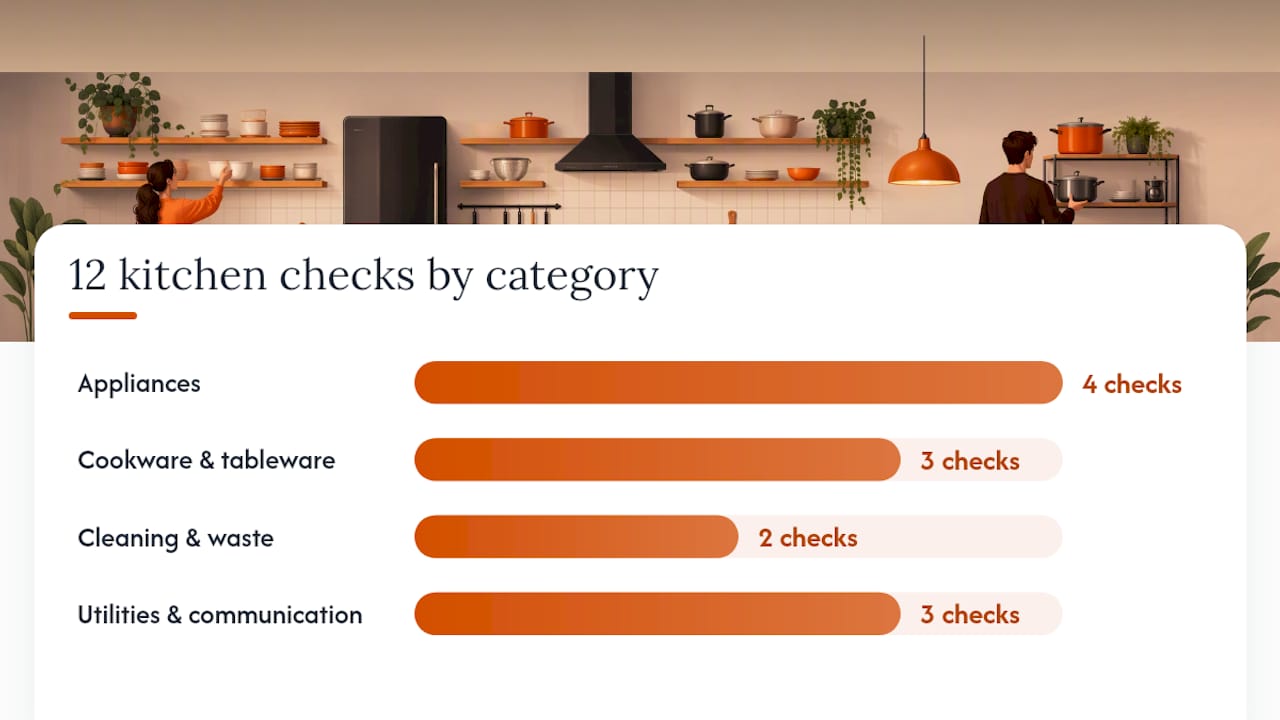
Whether you’re a renter deciding on a property or a host writing the description, the same twelve checks settle almost every dispute about what “fully equipped” actually delivers.
- Does the listing show a full-size oven, not just a microwave or hot plate?
- Is there a full-size refrigerator with a working freezer compartment?
- Is there a kitchen sink with hot and cold running water?
- Are pots and pans visible in photos, in at least two sizes?
- Are basic utensils (spatula, serving spoon, knife) mentioned or shown?
- Is there enough tableware (plates, bowls, cutlery) for the listed occupancy?
- Is a dishwasher present, and if not, is hand washing acceptable to you?
- Is a coffee maker or microwave included, if that matters to your routine?
- Are dish soap, sponges, or basic cleaning supplies mentioned?
- Does the range use gas, electric, or induction, and does that match your cooking style?
- Is trash disposal explained (bags provided, pickup schedule, disposal location)?
- If anything is unclear, has the host answered a direct message about it?
That last point matters more than people think. A checklist covering appliances, cookware, tableware, and cleaning supplies is the clearest way for both hosts to describe a kitchen and renters to evaluate one, rather than relying on the label alone. If a host can’t answer a specific question about the range or fridge within a reasonable time, treat that as useful information in itself.
For hosts, the fix is just as direct: list items instead of adjectives. A listing that spells out a specific inventory, rather than leaning on the phrase “fully equipped,” cuts down on guest questions before and during a stay.
How One Phoenix Rental Provider Handles Kitchen Inventory
Some furnished rental providers list specific kitchen inclusions on property pages rather than relying on a single catchall phrase, to reduce guest confusion. Typical unit descriptions may cover the range or oven, a refrigerator, a microwave, a coffee maker, cookware in various sizes, tableware and cutlery, and basic cleaning supplies like dish soap and trash bags.
That level of detail exists because a clear inventory and accurate photos reduce booking friction and guest complaints in furnished rentals. When a corporate traveler or a relocating professional can see exactly what’s in the kitchen before they arrive, they don’t need to message asking whether there’s a real oven or just a microwave, and they don’t show up disappointed.
For guests staying longer than a week or two, that same principle applies to what actually gets used most. A traveling nurse working twelve-hour shifts cares far more about a full-size fridge and a working range than about a specialty appliance she’ll never touch. Listings built around that reality tend to put the core appliances front and center in both headings and photos, rather than burying them under a stock phrase.
You can see this approach applied on individual property pages like Sunset Casita and Arcadia Executive Suite, where kitchen details sit alongside the rest of the unit’s amenities instead of getting a one-line mention.
Kitchen Standards Shift by Region and Building Type
What counts as “fully equipped” isn’t identical everywhere. Older buildings in dense American cities, particularly pre-war apartments in the Northeast, often have smaller kitchens with narrower appliance footprints than newer construction in the Southwest or South, where full-size ranges and larger fridges are closer to the default even in modestly priced units.
Building codes also shape what’s physically possible. The definition of a kitchenette as a cooking area under 80 square feet comes directly from building code language used in cities like New York, where compact footprints are common in older housing stock. A unit that would count as a full kitchen in Phoenix might legally qualify only as a kitchenette in a dense East Coast building simply because of square footage rules.
Hotel kitchens versus apartment kitchens tell a similar story. Extended-stay hotel suites usually include a compact range, small fridge, and basic cookware, but rarely match the storage and counter space of an actual apartment kitchen. Vacation rentals in tourist-heavy regions sometimes skew toward kitchenette setups because guests are assumed to eat out more, while corporate and relocation housing tends to lean toward full kitchens since those guests are staying and cooking for weeks or months at a time.
International terminology adds another wrinkle. Some European short-term rental listings use “kitchen corner” or “American kitchen” to describe open, integrated cooking spaces that would read as a full kitchen to an American renter, so terminology alone isn’t always a reliable guide.
Why the Kitchen Matters Differently Depending on Who You Are
A fully equipped kitchen isn’t equally important to every kind of guest, and treating it as a one-size checklist misses how differently people actually use these spaces.
Renters and relocating professionals staying a month or longer lean on a real kitchen to control food costs and eat on their own schedule, especially with unpredictable work hours. A traveling nurse coming off a night shift needs a fridge stocked with real groceries, not a mini fridge holding a few takeout containers.
Vacationers on a short trip often care less about cooking capacity and more about basics: coffee in the morning, a place to store leftovers, maybe breakfast before heading out. A kitchenette with a hob and decent fridge space can satisfy that need without any loss of trip quality.
Homeowners thinking about resale or their own daily use tend to weigh a fully equipped kitchen as a long-term investment rather than a short-term convenience, since it affects both livability and property value over years, not days.
Hosts and property managers sit in the middle. Advertising accurately protects them from bad reviews just as much as it helps guests pick the right property, and mismatched expectations around kitchen capability are one of the most common sources of guest friction in short-term rentals.
Who Keeps the Kitchen Running: Maintenance and Upkeep
A fully equipped kitchen only stays fully equipped if someone maintains it, and that responsibility splits differently depending on the type of stay.
In short-term and vacation rentals, the host or property manager typically handles appliance repairs, replacing broken cookware, and restocking basics like dish soap between guests. Renters are usually expected to leave the kitchen reasonably clean and report anything broken rather than attempt repairs themselves.
In mid-term furnished rentals and corporate housing, that split often shifts slightly. Guests staying weeks or months may be asked to handle routine cleaning and minor upkeep, like running the dishwasher’s cleaning cycle or defrosting the freezer if needed, while the property owner still covers major appliance failures such as a dead refrigerator compressor or a broken oven element.
Homeowners carry the full weight themselves: descaling coffee makers, replacing worn nonstick pans, checking that range burners ignite evenly, and eventually replacing appliances as they age out. A range typically lasts over a decade with basic care, while a refrigerator’s compressor is usually the first major component to fail.
Whoever holds the responsibility, the practical rule stays the same: report appliance problems early. A stove burner that won’t light or a fridge running warm rarely fixes itself, and waiting only turns a small repair into a bigger one.
How the Same Standard Looks Across Apartments, Hotels, and Vacation Rentals
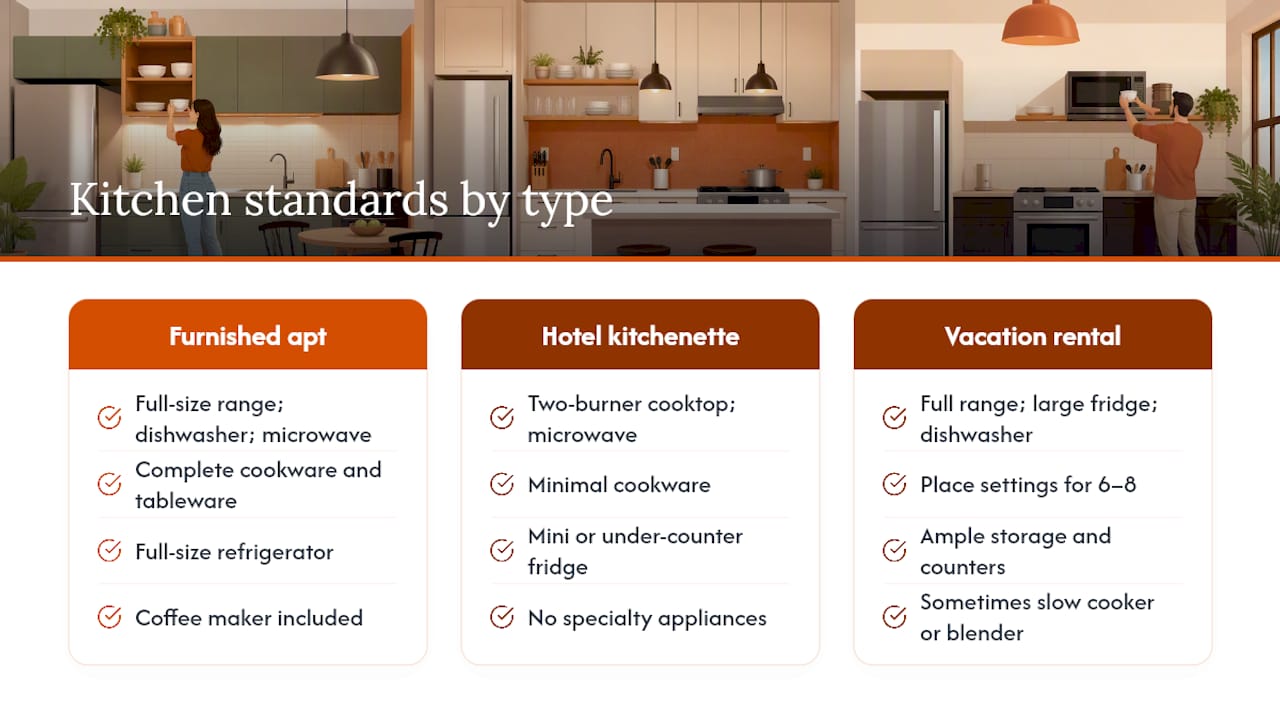
The phrase “fully equipped” stretches across very different physical spaces, and seeing a few side by side makes the standard easier to judge.
A furnished apartment built for a month-long corporate stay usually includes a full-size range, refrigerator, dishwasher, microwave, coffee maker, and a complete set of cookware and tableware for the unit’s occupancy. This is the fullest version of the standard, built for guests who will genuinely cook multiple meals a day over weeks.
A hotel room with a kitchenette, common in extended-stay chains, typically scales down to a compact two-burner cooktop or hot plate, a mini or under-counter fridge, a microwave, and minimal cookware, enough for simple meals but not a real dinner party. This setup matches the kitchenette definition rather than the full kitchen standard, even when hotel marketing calls it a kitchen.
A vacation rental house, especially larger ones built for groups, often exceeds the baseline with a full range, large fridge, dishwasher, and enough cookware and place settings for six or eight people, sometimes including specialty items like a slow cooker or blender since groups tend to cook more elaborate meals together.
Comparing these three side by side is the fastest way to spot which standard a listing is actually promising, regardless of what word it uses.
What I’d Actually Prioritize When Booking a Kitchen
If you cook daily, insist on seeing a real oven and full fridge in photos before you book. Ask directly if you’re unsure. If you’re mostly eating out and just need coffee and a place to reheat leftovers, a well-run kitchenette will serve you fine, and you shouldn’t pay extra chasing a full kitchen you won’t use. Either way, request inventory photos or a written list rather than trusting the phrase alone, and ask about any house rules on cooking, since a few properties restrict certain appliances for safety or insurance reasons. Fully equipped rentals exist specifically to remove this guesswork, which is worth remembering the next time a listing description feels a little too vague to trust.
— Sean
See What a Fully Equipped Kitchen Looks Like in a Phoenix Rental
Reading a checklist only gets you so far; seeing an actual inventory settles the question fast. Phoenixfurnishedrentals lists the specific kitchen contents on every property page instead of relying on a single label, so you know before you book whether you’re getting a full range and fridge or a smaller setup built for lighter cooking.
That matters most for the guests who lean on this article’s advice hardest: corporate travelers who need to cook after long days, relocating professionals settling in for weeks or months, and traveling nurses working shifts that don’t match a restaurant’s hours. Units, ranging from compact studios to larger multi-bedroom homes, may provide kitchen inventories spelled out rather than summarized in a single adjective.
If you’re weighing a stay in downtown Phoenix, check the available properties and their kitchen details directly, or look at a specific unit like Sunset Casita to see exactly what’s stocked before you commit to dates.
Sources
- What Is a Kitchenette? — Better Homes & Gardens
- What Is Considered a Fully Equipped Kitchen? — House Notebook
- fully-fitted kitchen — Collins Dictionary
- Fully equipped kitchen: how to choose | Scavolini Magazine
FAQ
Does a Fully Equipped Kitchen Include a Fridge?
Yes. A refrigerator with a working freezer is one of the core, non-negotiable components of a fully equipped kitchen, alongside a range/oven and a sink.
What Are the Main Types of Kitchens in Rentals?
Rentals typically fall into full kitchens, kitchenettes, open-plan “American kitchens,” and shared or communal kitchens found in some hostels and co-living setups; full kitchens and kitchenettes are the two you’ll see most often in listings.
What Does “Fully Equipped Kitchen Apartment” Mean?
It means the apartment’s kitchen includes the core appliances (range/oven, refrigerator, sink) plus enough cookware, tableware, and utensils to prepare and eat a complete meal without bringing your own gear. Properties like those listed by Phoenixfurnishedrentals itemize this inventory directly on the property page rather than relying on the phrase alone.
Does “Fully Furnished” Include Pots and Pans?
Not automatically. “Fully furnished” usually refers to furniture like beds, sofas, and tables, while pots, pans, and kitchen tools fall under “fully equipped.” A rental can be fully furnished without a stocked kitchen, so check both terms separately in the listing.
What’s the Difference Between Fully Equipped and Fully Stocked?
Fully equipped means the tools and appliances are there to cook with; fully stocked means the pantry also has consumables like coffee, oil, or basic seasonings. The two terms describe different things and a listing can offer one without the other.