
In-unit laundry means the washer and dryer sit inside your own apartment, not down the hall or across the parking lot. You get private, 24/7 access instead of shared machines or a laundromat run. The catch: landlords usually charge more rent, and your utility bill climbs a little too. Whether that trade pays off depends on how much your time is worth.
TL;DR:
- The rent premium for in-unit laundry commonly ranges from $100 to $175 per month, which can offset utility costs and convenience savings for frequent laundry users.
- Utility costs increase with in-unit washers and dryers, especially for water and electricity, and proper maintenance and ventilation are essential to avoid mold and fire hazards.
- Confirm the appliances are installed and functional during a tour by checking for leaks, venting, and appliance age, and request repair response times in writing.
- In short-term furnished rentals, in-unit laundry is often a critical amenity that simplifies packing and improves guest experience, with vetted appliances ensuring reliability.
Table of Contents
- What In-Unit Laundry Meaning Covers on a Listing
- Why Renters Pay More for In-Unit Laundry
- The Real Downsides of Washer Dryer In Unit Setups
- How to Estimate the Real Monthly Cost
- What to Check When You Tour an Apartment
- Why In-Unit Laundry Matters More for Short-Term Stays
- Book a Phoenix Rental With Laundry Already Handled
- Sources
- FAQ
What In-Unit Laundry Meaning Covers on a Listing
The RESO Data Dictionary, the standard reference real estate platforms use to tag listings, defines “In Unit” plainly: “Laundry is located within the unit.” No shared room, no separate building. The machines live inside your walls. In practice, that shows up a few different ways. Sometimes it’s a stacked washer/dryer tucked into a hallway closet. Sometimes it’s a side-by-side pair in a nook off the kitchen, or occasionally a bathroom corner. What matters is that they’re installed and ready to use.
That’s different from “hookups,” where the unit has the plumbing and electrical outlets but no actual appliances. You buy or rent your own washer and dryer. It’s also different from on-site laundry (a shared room somewhere in the building, often coin- or app-operated) and off-site laundromats, where you’re hauling bags to a business blocks away. RentCafe’s breakdown of laundry setups treats these as three distinct tiers of convenience. Pricing tends to follow the same order.
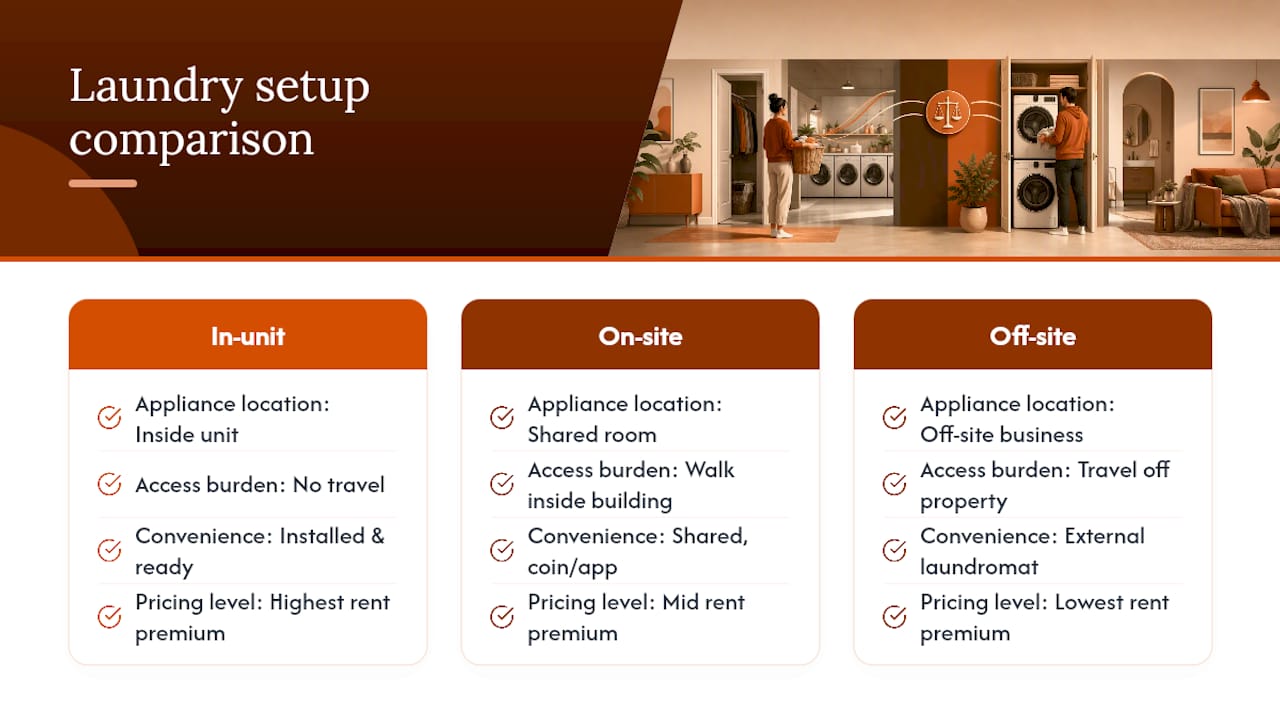
Why Renters Pay More for In-Unit Laundry
Convenience is the whole pitch, and it’s a real one. You do a load at midnight, fold in your living room, and never carry a hamper anywhere. No waiting for a machine, no quarters, no strangers touching your clothes.
The benefits break down like this:
- No commute for chores. Laundry happens between other tasks, not as a scheduled trip.
- Privacy. Nobody sees or handles your clothes but you.
- Fewer lost items. No mystery socks disappearing in a communal dryer.
- Lower per-load cost over time, since you’re not feeding coins or an app for every cycle.
- Best fit for specific lifestyles: families with constant loads, shift workers whose schedules don’t match laundry-room hours, and frequent travelers who need to pack fast.
RentCafe notes that convenience and time savings are the top reasons renters choose in-unit setups over shared alternatives, even knowing it costs more upfront.
Pro Tip: If you work irregular hours, in-unit laundry often pays for itself in stress alone. Communal laundry rooms tend to have unofficial “peak hours,” and missing that window means waiting a full day.
The Real Downsides of Washer Dryer In Unit Setups
The convenience isn’t free, and it’s not just about rent. In-unit laundry adds cost and risk in ways renters often don’t calculate until move-in day.
- Rent premium. Landlords price this amenity in, often adding $100 to $175 a month depending on the market, according to RentCafe’s reporting.
- Higher utilities. Water and electric use go up. The EIA’s residential energy data is a useful reference point for estimating how much a washer and dryer add to household electricity and water consumption.
- Lost square footage. A stacked unit in a studio can eat closet space you’d rather use for storage.
- You own the maintenance headache, or at least the hassle of reporting it. Leaks, worn hoses, and clogged vents are your problem to notice.
- Ventilation and mold risk. Dryers vented poorly, or not at all, can trap moisture in small closets.
The rent premium alone can wipe out any savings from skipping the laundromat, especially in a market where $150 extra a month is common.
How to Estimate the Real Monthly Cost
Figuring out whether in-unit laundry is worth it comes down to a simple comparison, not a gut feeling.
- Find the rent premium. Compare a similar unit with and without in-unit laundry in the same building or neighborhood. Ballpark industry figures put the premium around $100 to $175 monthly, but local markets vary a lot.
- Estimate the utility bump. Use EIA appliance energy data as a baseline for what a washer and dryer typically add to a household’s water and electric use.
- Add rent premium plus utility increase. That total is your real marginal monthly cost for having laundry at home.
- Compare it to laundromat or on-site costs, including your time. If the marginal cost beats what you’d spend (and lose in hours) elsewhere, in-unit wins. If not, hookups or on-site access might be the smarter call, especially for a short lease.
What to Check When You Tour an Apartment
Don’t take “in-unit laundry” at face value on a listing. Confirm it in person.
Walk through this quick list on a tour:
- Confirm the washer and dryer are actually installed, not just hookups waiting for your own machines.
- Run the water briefly and check under the machine for leaks or old water stains.
- Look at the dryer vent for lint buildup or signs it’s not vented outside at all.
- Check corners and behind the unit for mold or musty smell, a common sign of poor ventilation.
- Note the appliance brand and rough age. Older machines break down more.
Ask the leasing office directly who handles repairs and how fast they typically respond. Get that in writing if you can, since verbal promises about maintenance response times rarely hold up later.
Pro Tip: Clean the lint trap after every load and wipe the rubber door seal on front-load washers weekly. Both habits cut down on the two most common in-unit laundry complaints: fire risk and mildew smell, which fire-safety data links directly to appliance neglect.
Why In-Unit Laundry Matters More for Short-Term Stays
For a guest booking a furnished apartment for a few weeks or a few months, in-unit laundry isn’t a nice extra. It’s often the deciding factor. Nobody wants to pack a suitcase for a laundromat run in a city they don’t know.
Furnished rental operators tend to treat these appliances differently than a standard landlord would. Preventive maintenance gets scheduled instead of waiting for a complaint, and guests get clear instructions on the machines from day one, since a confusing dial or an unfamiliar app-controlled washer costs a host far more in frustration than the five minutes it takes to explain it. That’s the standard Phoenix Furnished Rentals properties are built around: reliable appliances and instructions that don’t require a guessing game.
Demand backs this up. NMHC’s renter demographic research shows convenience amenities consistently rank high in competitive rental decisions, and laundry sits near the top of that list.
Book a Phoenix Rental With Laundry Already Handled
Touring apartments to check hookups and inspect dryer vents is smart. Skipping that entirely is smarter if you’re only in Phoenix for a few weeks or a few months. Some furnished rental services list fully furnished properties where in-unit laundry comes standard, already installed and working, with no lease-signing gamble on whether the vent was ever cleaned.

Guests booking a stay skip the entire inspection checklist above, because the units are vetted before you ever walk in. Traveling nurses on assignment near the airport can check out the housing options built for shift schedules, and anyone drawn to a loft-style layout can look at the Desert Sky Loft, which lists in-unit laundry among its standard amenities. If you want the specifics on what’s included in a stay, check current availability and ask about appliance details for the property you’re considering.
Sources
For a deeper dive, the RESO Data Dictionary settles listing terminology disputes. RentCafe’s laundry breakdown and Redfin’s in-unit versus onsite comparison cover cost and convenience trade-offs in more detail. EIA’s residential energy data helps with utility math.
- RESO Data Dictionary — In Unit (LaundryFeatures)
- Apartment laundry options explained: In-unit, communal, laundromat (RentCafe)
- EIA residential energy consumption data (2020)
FAQ
What is the difference between onsite and in-unit laundry?
In-unit laundry means the washer and dryer are inside your own apartment for your exclusive use. Onsite laundry means shared machines somewhere else in the building, usually paid per load.
Is in-unit laundry worth it?
For most renters who value convenience and privacy, yes, especially shift workers, families, and frequent travelers, though it’s worth comparing the rent premium against what you’d spend at a laundromat first.
Is in-unit laundry cheaper than a laundromat?
Often, over time, since you’re not paying per load, but the upfront rent premium (commonly $100 to $175 a month) can offset those savings depending on how often you do laundry.
Are in-unit washers and dryers good?
They’re generally reliable when properly maintained, but age, brand, and ventilation quality vary a lot between units, which is why checking them on a tour matters.
Does Phoenix Furnished Rentals offer properties with in-unit laundry?
Yes, Phoenix Furnished Rentals lists furnished properties across Phoenix that include in-unit laundry as a standard amenity.