
A loft is an open, often industrial-derived living space built around height and light; an apartment is a purpose-built residential unit with defined rooms. Pick a loft if you want space, character, and room to entertain. Pick an apartment if privacy, storage, and predictable bills matter more than square footage.
TL;DR:
- Lofts typically have higher utility costs due to large windows and high ceilings, especially in hard lofts with minimal insulation.
- Lofts are found mainly in industrial zones with limited supply, which drives up prices and makes them more scarce compared to purpose-built apartments.
- Open-plan lofts often lack built-in storage and privacy, requiring renters to plan furniture or partitions to create separate zones.
- Soft lofts are newer constructions with industrial aesthetics that include modern insulation and amenities, making them more energy-efficient than traditional hard lofts.
- Renting a fully furnished loft through short-term rental services can eliminate setup costs and help tenants evaluate whether loft living suits their needs without long-term commitments.
Table of Contents
- Loft vs Apartment at a Glance
- What Is an Industrial Loft, Really?
- What Is an Apartment, Structurally Speaking?
- Hard Loft vs Soft Loft: The Distinction That Changes Everything
- Pros and Cons of Lofts and Apartments
- What Lofts and Apartments Really Cost You
- How to Choose Between a Loft and an Apartment
- Loft vs Studio Apartment: Where the Confusion Starts
- Where You’ll Find Lofts vs Apartments
- Renting vs Owning: Lofts and Apartments Compared
- Do Lofts or Apartments Hold Their Value Better?
- Amenities: What Comes With Each
- Who Actually Thrives in a Loft?
- Skip the Setup: Furnished Lofts Without the Guesswork
- Sources
- FAQ
Loft vs Apartment at a Glance
Before you spend a weekend touring listings, run through the basics. The differences between lofts and apartments show up in five or six practical categories, and most renters can rule out one option just by knowing their own habits.
- Layout: Lofts run open plan with few interior walls; apartments have separate bedrooms, living rooms, and kitchens.
- Ceilings and windows: Lofts often feature very high ceilings and oversized industrial windows; apartments use standard 8 to 9 foot ceilings.
- Storage: Apartments typically include closets; lofts frequently have none built in.
- Privacy: Apartments separate sleeping and living areas; lofts require furniture or partitions to create boundaries.
- Noise: Hard lofts transmit sound more easily due to exposed materials and fewer interior walls.
- Cost: Lofts tend to carry a premium tied to location and scarcity, not just size.
- Best for: Lofts suit creatives, entertainers, and remote workers who like open space. Apartments suit families, light sleepers, and anyone who wants lower, more predictable utility costs, as explained in Best areas for families with kids.
Pick a loft if you host often and want a space that photographs well. Pick an apartment if you need doors that close and a bill you can forecast.
What Is an Industrial Loft, Really?
A loft is a living space typically created from renovated industrial or commercial buildings, and it carries an open floor plan, high ceilings, and large windows as its signature traits, according to MasterClass. The term traces back to old factories, warehouses, and mill buildings converted for residential use once manufacturing moved out of city centers. Exposed brick, visible ductwork, steel beams, and concrete or wood-plank flooring are common carryovers from that industrial past.
The phrase “loft space” sometimes refers to a raw, unfinished area still zoned for commercial use, while a “loft apartment” is the finished, livable version with plumbing, electrical, and a lease attached. If a listing calls itself a loft but has drywall dividing every room, it is borrowing the aesthetic more than the substance.
What Is an Apartment, Structurally Speaking?
An apartment is a residential unit built from the ground up for people to live in, not a converted commercial shell. That distinction shapes everything else: separate bedrooms, dedicated closets, and HVAC systems designed room by room rather than for one giant volume of air.
Purpose-built construction also tends to isolate sound better between units, since apartment buildings are designed with sound control and defined room boundaries in mind from the start. For a family with young kids, a couple who works different shifts, or anyone who just wants a door to shut, that predictability outweighs a dramatic ceiling every time.
Hard Loft vs Soft Loft: The Distinction That Changes Everything
The industry splits lofts into two categories, and the difference affects price, comfort, and how much you’ll spend on space heaters. A hard loft is a true conversion, keeping the original industrial elements like brick walls, timber columns, and factory-grade windows. A soft loft is new construction designed to look the part, with the open layout and tall windows built in from day one, but paired with modern insulation, central HVAC, and amenities you’d expect in any new building.
Hard lofts feel more authentic but often lack centralized ventilation and proper insulation, which shows up on your utility bill in July and January alike. Soft lofts cost more upfront in many markets but run more efficiently and are easier to find outside of old industrial districts.
Pros and Cons of Lofts and Apartments
Neither format wins across the board, and the tradeoffs cluster around a few predictable themes.
Loft advantages: Extra square footage and ceiling height that apartments rarely match at the same price point, abundant natural light, and a layout built for entertaining large groups without feeling cramped. The open floor plan also means fewer walls dictating how you arrange furniture.
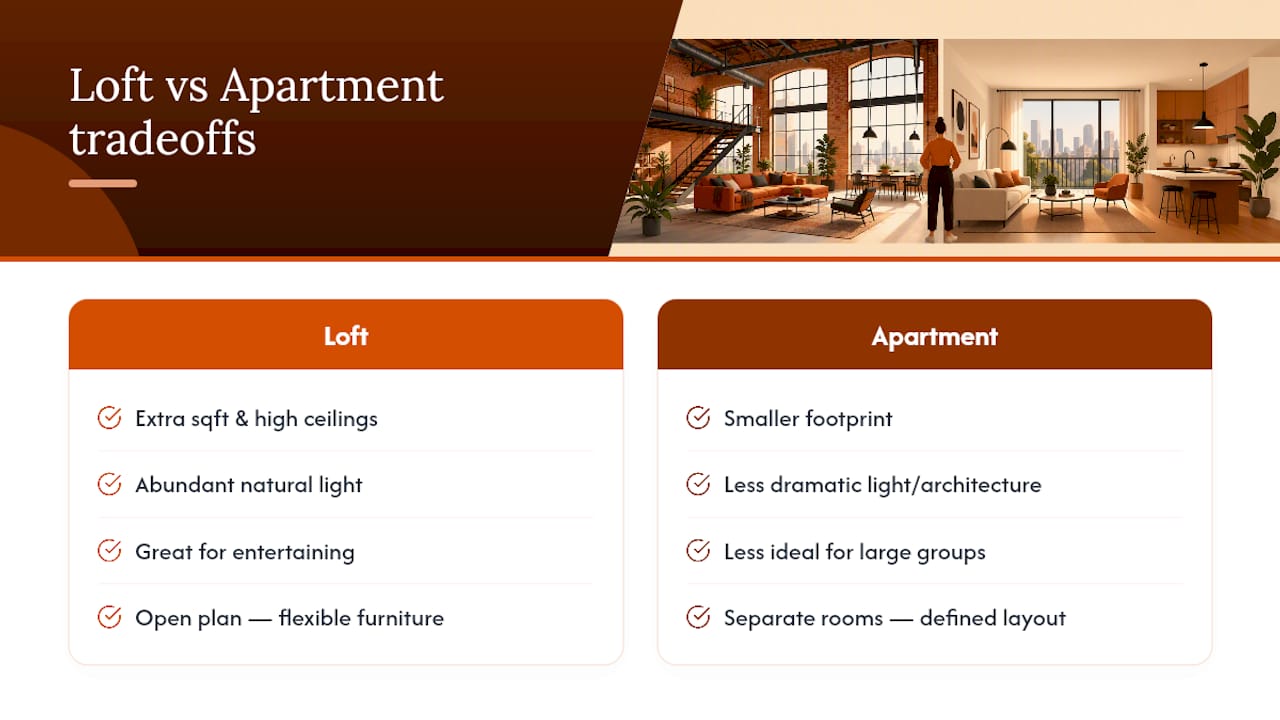
Loft drawbacks: Minimal privacy without added partitions, little to no built-in storage, and higher heating and cooling costs tied directly to that dramatic ceiling and glass. Hard lofts can also carry noise transfer between units since they often skip the soundproofing standard in newer buildings.
Apartment advantages: Separate rooms for privacy, dedicated closets, and generally tighter energy efficiency because the space is smaller and better sealed. That efficiency and predictability make apartments the safer bet for families or anyone on a fixed budget.
Apartment drawbacks: Less dramatic architecture, smaller footprints, and fewer opportunities for the kind of statement decor a raw brick wall gives you for free.
What Lofts and Apartments Really Cost You
Lofts frequently cost more than a comparably sized apartment, and the reason isn’t just square footage. Scarcity plays a bigger role: lofts cluster in downtown or converted industrial neighborhoods, and that limited supply against high demand pushes rents up compared to purpose-built apartments in less central areas. Add in the fact that a loft’s usable square footage often runs from around 1,000 to 2,000 square feet compared to a typical studio near 600 square feet, and the price difference is understandable.
Utilities follow the same logic. Large windows and towering ceilings mean more air to heat and cool, and older hard-loft buildings rarely have the insulation to make that efficient. Furnishing costs add up too. An open floor plan needs enough furniture, rugs, and lighting to break the space into functional zones, or it ends up feeling like an empty warehouse rather than a home.
A few fixes help either way: thermal curtains over industrial windows cut drafts noticeably, a smart thermostat with zone sensors keeps you from heating rooms you’re not using, and area rugs or low bookshelves can define “rooms” in an open loft without a single wall going up.
How to Choose Between a Loft and an Apartment
Run through this checklist before you sign anything, especially if you’re torn between the aesthetic of a loft and the practicality of an apartment.
- Rank your priorities. Privacy, entertaining space, storage, budget, commute, and noise sensitivity rarely align perfectly. Know which two matter most.
- Ask about insulation and HVAC. In a hard loft, ask directly whether the building has central heating and air or window units, and request average utility bills from the property manager or a past tenant.
- Check the storage situation. Open-plan lofts usually provide less built-in storage than apartments with dedicated closets, so measure what you actually own against what’s offered.
- Ask about noise. Exposed brick and concrete carry sound differently than drywall. Ask what’s directly above, below, and next to the unit.
- Look for red flags. Vague answers about conversion permits, unusually high utility estimates, or no mention of insulation at all are signs to dig deeper before committing.
Pro Tip: If you fall for a loft but need privacy, a tall bookshelf, a rolling partition, or even heavy curtains on a tension rod can carve out a bedroom nook without touching the lease terms on modifications.
Loft vs Studio Apartment: Where the Confusion Starts
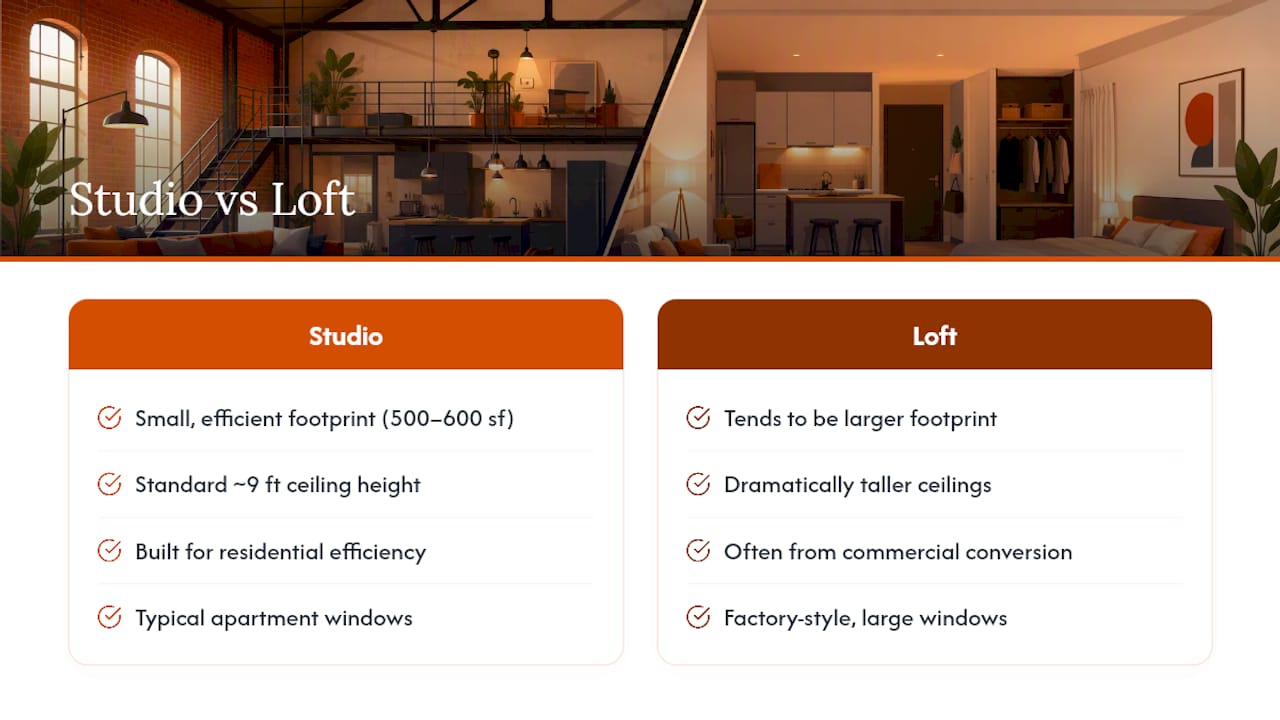
People often use “loft” and “studio” interchangeably, but they describe different things. A studio apartment is simply a small unit, usually one open room plus a bathroom, built for efficiency rather than character. A loft is defined by its architecture and ceiling height, not its size, though many lofts happen to be studio-style in that they lack separate bedrooms.
The real distinction is scale and origin. A studio in a standard apartment building might run 500 to 600 square feet with a standard 9 foot ceiling. A loft, even a small one, tends to run larger with dramatically taller ceilings and factory-style windows, and it usually descends from a commercial building rather than a residential blueprint. Some listings market a small loft as a “loft studio,” which just means an open, ceiling-heavy unit with no separate bedroom, essentially a studio with industrial styling layered on top.
The practical takeaway: if a listing says “studio,” expect efficient use of a small footprint. If it says “loft,” expect more vertical space and bigger windows, but don’t assume it comes with a separate bedroom just because the square footage sounds generous. Always check the floor plan, not just the label, since marketing language varies wildly between buildings and cities.
Where You’ll Find Lofts vs Apartments
Geography tells you a lot about which option you’ll actually find available. Lofts concentrate in former industrial zones: old warehouse districts, historic downtown cores, and neighborhoods that went through a wave of adaptive reuse as manufacturing left. That clustering is exactly why lofts carry a price premium tied to location and scarcity, not just architecture.
Apartments spread far more evenly. Purpose-built residential buildings exist in suburbs, mid-rise corridors, and downtown high-rises alike, which gives renters far more geographic flexibility and, usually, more competitive pricing. If your job requires a specific commute or school district, an apartment search will almost always give you more viable neighborhoods to choose from than a loft search will.
This geography also shapes lifestyle. Loft neighborhoods tend to come with walkable restaurants, art galleries, and nightlife, since they grew out of urban cores. Apartment-heavy neighborhoods run the full spectrum from dense downtown towers to quiet residential streets, so the “typical” apartment neighborhood really depends on the city and the specific building you’re considering.
Renting vs Owning: Lofts and Apartments Compared
Most lofts and apartments enter the market as rentals first, but ownership paths differ once you look closer. Loft ownership usually comes through condo conversions, where a developer buys an old industrial building, converts individual units, and sells them much like condos in any other building. That means loft buyers often deal with a condo association, shared maintenance fees for the building’s aging infrastructure, and sometimes stricter rules about modifying the open layout.
Apartment ownership is less common by definition, since most apartment buildings stay under single ownership with tenants renting individual units. When apartment-style units are sold, they’re usually structured as condos in a purpose-built building, which tends to come with more predictable maintenance costs since the building wasn’t repurposed from another use.
For renters specifically, the practical difference comes down to lease flexibility and what you’re responsible for. Loft leases in older buildings sometimes shift more maintenance responsibility onto the tenant, particularly around older windows or exposed plumbing. Apartment leases in professionally managed buildings tend to spell out maintenance responsibilities more clearly, since the systems are newer and better documented. Anyone weighing a long-term stay should ask directly who handles repairs on original industrial features, since that answer varies building to building far more than it does with standard apartments.
Do Lofts or Apartments Hold Their Value Better?
Location drives loft value more than almost any other factor, because scarcity in converted industrial neighborhoods keeps demand high even when a building itself is decades old. As cities gentrify old warehouse districts, lofts in those areas often see faster price appreciation than comparable apartments a few miles away, simply because there’s a fixed supply of convertible buildings and no way to build more once the historic stock runs out.
Apartments appreciate on a steadier, more predictable curve tied to broader housing market trends, since new construction can expand supply in ways that loft conversions cannot. That makes apartments a safer long-term bet for value stability, while lofts carry more upside in hot downtown markets and more risk in neighborhoods where the industrial charm hasn’t caught on with buyers yet.
For renters, this mostly matters indirectly: strong appreciation in loft-heavy neighborhoods often means rent increases follow the same curve, so that trendy warehouse district can get considerably more expensive within a few lease cycles. Apartment rents in steadily appreciating neighborhoods tend to climb more gradually, which matters if you’re planning to stay put for several years.
Amenities: What Comes With Each
Newer apartment buildings tend to bundle in amenities that lofts, especially hard lofts, often skip entirely: fitness centers, package rooms, on-site management, elevators, and sometimes pools or shared workspaces. Because apartment complexes are built as single developments, it’s easier for a property manager to justify shared amenities across dozens or hundreds of units.
Lofts, particularly older hard-loft conversions, sometimes operate more like individual units with minimal shared services beyond basic building maintenance. Soft lofts split the difference, since they’re new construction and often built into mixed-use developments that include the same amenity packages you’d find in a standard apartment complex, just wrapped in an industrial aesthetic.
Design trends have also shifted what “loft style” looks like on the amenity side. Newer soft lofts increasingly favor warmer palettes and reclaimed-wood accents over the stark, all-concrete industrial look that defined earlier conversions, making them feel more finished and less like a repurposed factory floor. If building amenities matter to your daily routine, gym access or a doorman especially, ask directly rather than assuming a “loft” building operates like a full-service apartment complex.
Who Actually Thrives in a Loft?
Creatives who need a wall for art, remote workers who want a dedicated desk zone without a hallway in between, and people who genuinely entertain often are the ones who report loving loft living a year in. The surprises tend to hit the same two spots every time: utility bills that run higher than expected in extreme heat, and the real cost of furniture needed to make an open floor plan feel like separate rooms.
None of that makes a loft a bad choice. It makes it a choice that rewards planning. Weigh the aesthetic against the recurring costs honestly, and talk to current tenants about their bills before you fall for the exposed brick.
— Sean
Skip the Setup: Furnished Lofts Without the Guesswork
Some rental services solve the exact tradeoffs this article just walked through. Instead of signing a year-long lease on a raw loft and then spending weeks furnishing an open floor plan, zoning it for privacy, and hoping the HVAC keeps up with summer heat, you can book a space that’s already done.
Every unit comes fully furnished, climate controlled, and stocked with the storage solutions open lofts usually lack, so you get the high ceilings and natural light without the furniture bill or the guessing game on utility costs. Flexible short and mid-term lease options mean you’re not locked into a year just to test whether loft living suits you. Properties like the Desert Sky Loft give you the industrial character this article describes, minus the setup headaches, and corporate travelers or relocating professionals can see how the model fits their timeline through the switching guide for relocating professionals. Check availability and book a stay directly through Phoenix Furnished Rentals.
Sources
Key definitions and comparisons referenced here come from MasterClass, Apartments.com, Wikipedia’s entry on lofts, and Bay Property Management Group. Always confirm current listings and utility estimates for your specific city before deciding.
- What Is a Loft? 4 Differences Between Lofts and Apartments – 2026 – MasterClass
- Apartments
- Loft – Wikipedia
FAQ
Are lofts better than apartments?
Neither is objectively better. Lofts win on space, light, and character; apartments win on privacy, storage, and lower ongoing costs, so the right choice depends on your priorities.
What are the disadvantages of lofts?
Lofts often lack built-in storage and full privacy, and their high ceilings and large windows tend to raise heating and cooling costs compared to standard apartments.
Is a loft considered an apartment?
A loft can function as an apartment, but it’s technically a distinct housing type built from a converted or loft-style structure, defined by open layouts and industrial features rather than traditional room divisions.
Is a loft considered luxury?
Some lofts carry a luxury price tag due to their downtown locations and scarcity, but “loft” itself refers to a style and layout, not a price tier. Options like a furnished stay through Phoenix Furnished Rentals can offer that aesthetic without a long-term luxury lease commitment.