
The fastest way to protect your daytime sleep on a night-shift contract is a fully furnished rental that guarantees three things before you sign anything: complete blackout, real quiet, and climate control you can set between 60 and 67°F. One option built around exactly this need is a fully furnished rental service specialising in quiet, dark, and climate-controlled units. Start your search 4 to 6 weeks before your contract begins, and lean on extended-stay housing only as a bridge if your start date is closer than that; also, be aware of how to prevent bed bugs when you travel to protect your new rental environment from unwanted pests by following practical guidance on preventing and identifying bed bugs in temporary rentals.
TL;DR:
- Book housing at least four to six weeks in advance to ensure availability of units that meet blackout, quiet, and climate control needs.
- Confirm the rental has adjustable thermostat access and blackout coverings, preferably requesting professional installation before move-in.
- Prioritize units on upper floors, inner-facing, or with sound-rated windows for optimal noise reduction, especially in busy or noisy areas.
- Use a portable sleep kit with blackout liners, white-noise devices, and blue-light blocking sunglasses to optimize daytime sleep quality.
- Limit caffeine intake to the first half of your shift and avoid late naps to prevent interference with your main daytime sleep window.
Table of Contents
- What Makes a Furnished Rental Right for Travel Nurse Night Shift Sleep?
- Where Should You Search, and How Far in Advance?
- How Do You Book Without Getting Burned by Cancellations?
- How Do You Turn a Furnished Unit Into a Real Daytime Sleep Space?
- What Belongs in Your Sleep Kit, and What Do You Check First?
- What Should You Eat and Drink to Sleep Better During the Day?
- How Should You Nap Without Wrecking Your Main Sleep?
- How Do You Manage the Mental Load of Night Shift Work?
- Does Caffeine Help or Hurt Your Daytime Sleep?
- Is It Safe to Drive Home After a Night Shift?
- What Have We Learned Hosting Travel Nurses in Phoenix?
- Book Sleep-Ready Furnished Housing With Phoenix Furnished Rentals
- Sources
- FAQ
What Makes a Furnished Rental Right for Travel Nurse Night Shift Sleep?
Before you scroll through another listing, run it against a short list of pass/fail criteria. Most furnished-rental photos are shot to sell the living room, not to answer the one question that actually matters to you: will this room be dark and quiet at 10 a.m.?
Must-haves:
- Confirmed blackout, whether that means existing blackout blinds or a host who will let you install temporary panels
- Independent HVAC control in the unit, not a shared building system on a timer
- A quiet location: upper floor, inner-facing unit, away from elevators, trash chutes, or a busy street
- Double-pane windows or some documented sound rating, especially near an airport or a stadium district
Nice-to-haves: in-unit laundry, a dedicated desk for charting, secure parking, a working lockbox for late arrivals, and a clear pet policy if you travel with an animal.
Ask for daytime photos or a live video walkthrough of the bedroom, not just staged evening shots. Ask directly whether the building has had recent construction and whether previous tenants were healthcare workers on night rotations. Hosts who’ve hosted nurses before usually know exactly what you’re asking and why.
Pro Tip: A five-minute video call where the host pans the bedroom windows and knocks on the wall tells you more about sleep quality than ten professional photos ever will.
Where Should You Search, and How Far in Advance?
Skip the generic vacation-rental search bar and go straight to platforms built for mid-term, work-based stays. General booking sites bury month-long listings under thousands of weekend getaways.
- Use mid-term rental platforms and specialist travel-healthcare housing sites alongside Airbnb or VRBO, filtered specifically for stays of 28 nights or longer, which is usually the threshold that unlocks monthly pricing
- Search by the hospital’s street address rather than the city name, so results sort by actual commute distance
- Set saved alerts so new listings near your facility hit your inbox before they’re gone
- Run the commute at the real time you’d drive it, meaning 6:30 a.m. or 7 p.m., not noon on a Tuesday
Facebook groups and word-of-mouth from other traveling clinicians also turn up units that never get listed publicly, according to StellarNurse’s housing overview.
Timing drives everything here. Landlords holding inventory for traveling professionals tend to book up fast, and the best furnished options disappear inside a 4 to 6 week window before a contract starts. If your assignment starts in two weeks, don’t panic. Book an extended-stay hotel or a flexible short-term rental as a bridge, then move once you find the right long-term fit.
How Do You Book Without Getting Burned by Cancellations?
Booking method matters as much as the unit itself. Agency-arranged housing trades some control for convenience: less searching, but less say over the specific building or floor plan. Self-booking with your stipend gives you full control over blackout, quiet, and location, but you own the research and the risk.
- Decide upfront whether you want agency housing or stipend-based self-booking, and check your agency’s per-diem rules before you commit to a lease
- Ask the host for a monthly discount, since most furnished-rental pricing softens noticeably past a 28 or 30-night stay
- Request blackout curtains be installed before move-in if they aren’t already there. Many hosts will do this for free rather than lose a booking
- Negotiate a short cancellation window or an assignment-change clause. Contracts get pulled or shortened, and you need an exit that doesn’t cost you a month’s rent
- Confirm what’s included: utilities, WiFi, and parking costs can turn a “great rate” into a mediocre one fast
- Before you pay a deposit, get a live video tour, confirm the exact address on a map, and drive the commute at 7 a.m. on a trial run if you’re local enough to do it
Get every cancellation and termination term in writing. Vetting hosts through video tours and confirming exact addresses before payment catches problems a listing photo will never show you.
How Do You Turn a Furnished Unit Into a Real Daytime Sleep Space?
Even a well-chosen rental usually needs a few adjustments the first day. None of these require a toolbox or a big budget.
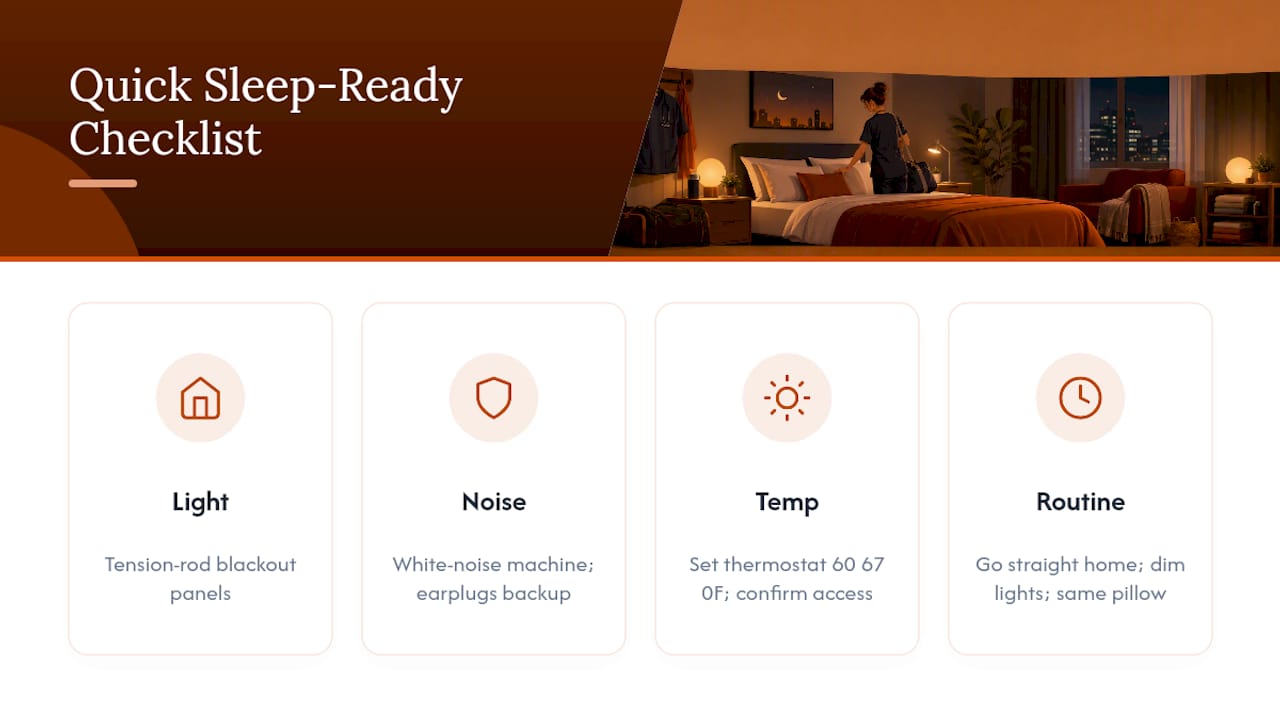
Blackout, dialed in. Tension-rod blackout panels install in minutes over existing curtain rods and travel well between assignments. Removable blackout liners work if the unit already has decent curtains but not enough light-blocking fabric. A high-quality sleep mask is your backup for the first night before you’ve fixed anything. Test the room at actual midday brightness, not at dusk when everything looks darker than it will be at 11 a.m.
Noise, handled in layers. A white-noise machine or app covers traffic, neighbors, and HVAC hum better than earplugs alone, though earplugs are worth keeping as backup for construction days. If your bed sits against a street-facing wall, move it. A door sweep or draft stopper blocks hallway noise and light bleeding in under the door, a fix most people never think to make.
Temperature, set and left alone. Sleep researchers put the optimal sleep temperature range at 60 to 67°F, a window most rentals can hit with a programmable thermostat. Confirm you have direct thermostat access before you book. In dry desert air, a small humidifier prevents the parched-throat makeups that cool, dry rooms sometimes cause.
Routine, protected. Go straight home after your shift rather than running errands first. Keep the lights low the moment you walk in, and use the same pillow and linens every rotation so your brain gets a consistent cue that it’s time to sleep. Put on blue-light-blocking sunglasses for the drive home. That single habit, flagged specifically for night-shift commuters, keeps morning sunlight from telling your brain it’s time to be awake right when you need the opposite.
Pro Tip: Pack the blackout liner and white-noise device in your carry-on, not checked luggage. If your flight gets delayed and you land the same day your shift starts, you’ll want to fix the room in the ten minutes you have, not dig through a suitcase.
What Belongs in Your Sleep Kit, and What Do You Check First?
Build a portable kit once and reuse it every contract. It should include removable blackout material, a compact white-noise device or backup earplugs, blue-light-blocking sunglasses, your own pillow, a power strip and short extension cord, and a printed or photographed copy of the thermostat instructions if the unit uses an unfamiliar system.
In your first 24 hours in a new unit:
- Inspect every window and door lock, and note anything that doesn’t latch properly
- Run a daytime noise test by sitting in the bedroom for ten minutes during a normal weekday midday
- Set the HVAC to your target range immediately, rather than waiting until you’re exhausted
- Cover or unplug any bright standby lights on electronics near the bed
- Drive the actual commute at your actual shift time and confirm where you’ll park
- Photograph the unit’s condition for your own records before you unpack
If the noise test or the blackout fails, don’t tough it out for a month. Have a fallback extended-stay option identified in advance, and know exactly who to call: the host, or your agency’s housing coordinator, the same day.
What Should You Eat and Drink to Sleep Better During the Day?
What you eat in the two hours before daytime sleep affects how fast you fall asleep and how long you stay asleep. A heavy, high-fat meal right after a 12-hour shift tends to sit in your stomach and delay sleep onset, even when you’re running on fumes.
Lean toward a lighter meal with protein and complex carbohydrates instead of fried food or a large portion eaten in a rush. Oatmeal, eggs, a turkey sandwich, or a bowl of rice and vegetables digest more easily than a drive-through burger at 7 a.m.

Hydration matters just as much, but timing it wrong backfires. Drinking a large glass of water right before bed guarantees a bathroom trip that breaks your sleep cycle in the middle of the day, when it’s already harder to fall back asleep. Hydrate steadily through your shift instead, and taper fluid intake in the final hour before you plan to sleep.
Alcohol deserves a specific warning here. A drink to “wind down” after a shift might help you fall asleep faster, but it fragments sleep in the second half of the cycle, which is exactly the stretch you need most when you’re only getting one sleep window in daylight hours. Skip it on workdays if you can, and save it for your stretch of days off.
How Should You Nap Without Wrecking Your Main Sleep?
A short nap before a night shift can measurably sharpen your alertness for the first few hours on the floor. The trick is keeping it short enough that you wake up refreshed instead of groggy.
A 20 to 30 minute nap in the early afternoon, roughly four to six hours before your shift starts, tends to work best. Anything longer risks pushing you into deep sleep, and waking up out of that stage leaves you foggier than if you hadn’t napped at all.
If you’re mid-shift and your unit has an on-site break room, a quick 15 to 20 minute nap during a lull can help bridge the 3 a.m. slump many nurses hit regardless of how well-rested they were going in. Set a hard alarm. The goal is a light doze, not a sleep cycle.
Avoid napping in the two or three hours right before your scheduled daytime sleep block. A late nap steals sleep pressure from the main event, and you’ll end up staring at the ceiling during the hours you actually need to be unconscious.
How Do You Manage the Mental Load of Night Shift Work?
Night shift work carries a psychological weight that daytime scheduling rarely does. Isolation is the biggest one. Your friends and family are awake and social while you’re trying to sleep, and asleep while you’re at work. That mismatch adds up over a 13-week contract, especially somewhere new where you haven’t built a local support network yet.
Build small anchors into your schedule that don’t depend on anyone else’s clock. A consistent pre-shift ritual, whether it’s a specific playlist, a short walk, or a few minutes of stretching, gives your brain a signal that the workday is starting even when the sun says otherwise.
Clustering your shifts and keeping a consistent sleep window on your days off, rather than flipping back to a normal schedule and then flipping again, tends to ease the circadian adjustment. Constant back-and-forth switching is often harder on your mood and focus than staying nocturnal through your whole rotation.
If irritability, flattened mood, or persistent low energy start showing up beyond normal tiredness, that’s worth naming out loud, either to a trusted colleague, your agency’s support line, or a mental health professional. Night shift fatigue and clinical burnout can look similar from the outside, but they call for different responses.
Does Caffeine Help or Hurt Your Daytime Sleep?
Caffeine is a tool, not a crutch, and the timing matters more than the total amount most nurses drink. A cup of coffee at the start of your shift can sharpen focus for the next several hours. The same cup taken three hours before your shift ends usually stays in your system long enough to delay sleep onset once you get home.
Caffeine has a half-life of roughly five to six hours in most adults, meaning half of what you drink at 2 a.m. is still active in your bloodstream at 7 or 8 a.m. Cut off intake in the back half of your shift, ideally by the midpoint, so it has time to clear before you’re trying to fall asleep.
Energy drinks and pre-workout supplements deserve extra scrutiny. Many pack far more caffeine than a standard cup of coffee, plus additional stimulants that stack on top of it, and the effects can linger well past what the label suggests. If you’re reaching for one every shift just to function, that’s usually a sign your sleep debt is the real problem, not your energy levels.
Nicotine carries a similar stimulant effect and can interfere with sleep onset in much the same way caffeine does, particularly if used in the hour before bed.
Is It Safe to Drive Home After a Night Shift?
Driving after 12 hours awake carries real risk, and the science here is not subtle: reaction times after extended wakefulness can resemble those of a legally impaired driver, even without a drop of alcohol involved.
Roll your windows down or blast the air conditioning for the first stretch of the drive if you feel your eyes getting heavy. Keep the radio at a normal volume rather than silence, which makes drowsiness worse. If you catch yourself missing exits, drifting in your lane, or losing track of the last few minutes, pull over. A 15-minute break in a well-lit parking lot beats pushing through and risking a crash.
If your commute regularly runs 30 minutes or longer, consider carpooling with another night-shift colleague on overlapping schedules, or look at housing closer to the hospital specifically to shorten this window. The blue-light-blocking sunglasses habit mentioned earlier for protecting your sleep cycle also happens to reduce glare and eye strain on the drive, which helps with alertness at the wheel too.
Never treat the drive home as a formality to push through on autopilot. It’s the last physically demanding task of your shift, not an afterthought at the end of it.
What Have We Learned Hosting Travel Nurses in Phoenix?
Across the units we manage, the single feature that predicts a good review from a night-shift nurse isn’t the kitchen or the furniture. It’s whether the bedroom stays genuinely dark at noon in a desert city where the sun does not cooperate.
We’ve added blackout panels to units before check-in more than once after a nurse called ahead and asked specifically. We’ve also had guests discover on arrival that a “quiet street” listing sat two blocks from a fire station, which is exactly the kind of detail a daytime video call would have caught. Ask for one before you book anywhere, including with us.
What we can’t fully replicate through a listing page is judgment. No amount of amenities substitutes for asking direct questions before you sign, and hosts who’ve worked with healthcare travelers before will usually welcome those questions rather than dodge them.
— Sean
Book Sleep-Ready Furnished Housing With Phoenix Furnished Rentals
If you’re choosing between a generic short-term rental and something purpose-fit for a night-shift schedule, Some rental services offer units built around the three checkpoints covered in this guide: blackout, quiet, and climate control you can set yourself. Instead of negotiating with a stranger over a shared listing, booking directly with a local operator familiar with night-shift schedules can be beneficial.
Options range from a compact studio layout for a single traveler to larger units with dedicated workspace for charting between shifts, and properties like the Sunset Casita show what a sleep-ready furnished rental looks like in practice. Before booking, it is advisable to request daytime bedroom photos or a live video walkthrough, and to ask directly whether blackout curtains are installed or can be added before the move-in date. If you’re relocating for a longer rotation, the corporate housing option is worth a look too.
Check current availability and start a conversation about your shift schedule directly on the Phoenix Furnished Rentals booking page.
Sources
- ACEP sleep hygiene guidance (sleep environment recommendations)
- NURSA: How to find housing as a travel nurse
- How to find furnished housing for travel nurses (timing and search tactics)
FAQ
How far ahead should I book housing for a night-shift contract?
Start searching 4 to 6 weeks before your contract begins to get the best selection of furnished units with blackout and quiet features already in place.
What temperature is best for sleeping during the day?
A range of 60 to 67°F is generally recommended for optimal sleep, and any furnished rental you consider should give you direct thermostat control to hit that range.
What if my assignment starts in less than two weeks?
Book an extended-stay hotel or a flexible short-term rental as bridge housing, then transition to a better-suited furnished rental once you find one, since these hotels can have more daytime noise from housekeeping.
Can I ask a host to install blackout curtains before I move in?
Yes, many hosts will install tension-rod blackout panels or liners at no cost rather than lose a booking, and it’s worth asking before you sign, including through providers like Phoenix Furnished Rentals.
Is caffeine safe to drink during a night shift?
Caffeine works best early in your shift, since its roughly five to six hour half-life means anything consumed in the last few hours before you clock out can delay your sleep once you get home.