
Start your Phoenix move by choosing the right sub-area, then book a short-term furnished stay while you search homes in that micro-market. Median gross rent in the city runs $1,582, and summer cooling costs add real weight to any budget. A flexible option like Phoenix Furnished Rentals lets you settle in fast while you compare East Valley, Scottsdale, Tempe, West Valley, and Central Phoenix on the ground.
TL;DR:
- Neighborhood boundaries, school zones, and commute routes can significantly affect your daily life and costs, so verify them thoroughly before committing.
- Short-term furnished rentals offer flexibility to explore neighborhoods, test commutes, and assess local amenities without a long-term lease or purchase commitment.
- Summer moving requires early planning for carrier booking, early morning scheduling, and confirming cooling systems to avoid extreme heat risks.
- Utility setup, HOA reviews, and safety checks should be prioritized to prevent disputes, high costs, or safety hazards during the first months in a new home.
- Living costs vary by neighborhood, with utilities and transportation expenses fluctuating seasonally and depending on your chosen sub-area.
Table of Contents
- How Greater Phoenix breaks down: neighborhoods and micro-markets to consider
- Housing market snapshot and realistic cost expectations
- Renting vs buying and short-term/temporary housing options for newcomers
- Moving logistics and timing: heat-aware move planning, carriers, and utilities setup
- Neighborhood-first checklist: commute, schools, sun orientation, HOA and red flags
- Furnished rentals and temporary-stay strategy: first-hand guidance from Phoenix Furnished Rentals
- City services and tenant protections you need to set up
- What it costs to live in Phoenix beyond rent or a mortgage
- School districts and education options by neighborhood
- Safety and crime patterns to weigh by area
- Amenities and lifestyle factors that shape neighborhood desirability
- Handling Phoenix heat during your move and first days
- Common relocation pitfalls specific to Phoenix
- Lessons learned and common mistakes to avoid
- How Phoenix Furnished Rentals helps relocators
- Sources
- FAQ
How Greater Phoenix breaks down: neighborhoods and micro-markets to consider
Phoenix is not one housing market. It is a collection of micro-markets, each with its own price point, commute pattern, and lifestyle, and picking the right one matters more than picking the right house.
- East Valley (Chandler, Gilbert, Mesa): family-oriented, tech-heavy job base, and newer master-planned communities with strong school reputations.
- Scottsdale and the northeast: resort-style living, golf courses, and the highest price tier in the region.
- Tempe: anchored by Arizona State University, dense and walkable, with a rental market skewed toward apartments and shared housing.
- West Valley (Glendale, Peoria, Buckeye, Surprise): newer construction, larger lots, and more square footage per dollar than the east side.
- Central Phoenix pockets (Willo, Encanto-Palmcroft, Arcadia): historic bungalows and midcentury homes mixed with urban amenities and a wide price spread.
The practical differences that matter for someone relocating are rarely about curb appeal. Commute corridors along Loop 101, Loop 202, and I-17 determine whether a 20-minute drive becomes 45 minutes at rush hour. School district boundaries can split two houses on the same street into different attendance zones. HOA prevalence is heavy in the East Valley and West Valley master-planned communities, lighter in older Central Phoenix neighborhoods. Short-term rental density (a factor if you care about neighbor turnover or future resale flexibility) tends to run higher near Scottsdale and downtown Phoenix than in family-heavy suburban tracts.
Housing market snapshot and realistic cost expectations
City-wide figures are a starting point, not a forecast for any single neighborhood. As of the 2020 to 2024 period, the median gross rent in Phoenix was $1,582, and the median value of owner-occupied housing units was $420,700. Median monthly owner costs for a home with a mortgage ran $1,847, compared with $559 for owners without one, a gap that shows how much financing terms shift a household budget.
Owner-occupied households make up 57.3% of Phoenix housing, according to Census QuickFacts, which reflects a market where renting is common but far from the default.
A few things push actual costs above or below the city median:
- Scottsdale and parts of North Central Phoenix run well above the city median for both rent and purchase price.
- West Valley suburbs and older East Valley tracts often land below it.
- Utilities swing seasonally. Summer cooling can add a substantial amount to monthly electric bills compared with the shoulder seasons, so budget for a wider range than you would in a milder climate.
Treat the city figure as a floor for planning conversations, then adjust once you have a target neighborhood and property type.
Renting vs buying and short-term/temporary housing options for newcomers
Rushing into a 12-month lease or a home purchase before you understand daily life in a neighborhood is one of the most common relocation mistakes, which a neighborhood-first relocation planning approach helps to avoid. A furnished, short-term stay buys you time to test commute times, school zones, and noise levels without a long commitment.
- Standard Phoenix leases typically run 12 months, with a security deposit and proof of income requested at application.
- Furnished mid-term rentals, by contrast, often allow stays measured in weeks or months rather than a full year.
- Month-to-month terms, pet policies, and included utilities vary by property, so confirm them before booking.
Pro Tip: Book a furnished stay in your target sub-area for 30 to 60 days, then use that window to tour homes in person before signing anything long term.
A furnished rental also removes the logistics of setting up utilities, buying furniture, and coordinating movers on day one, which matters when you are also job-hunting or starting a new position. For families weighing a purchase, this window is often what separates an informed offer from a rushed one.
Moving logistics and timing: heat-aware move planning, carriers, and utilities setup
Phoenix summers change how you should plan a move. Peak heat runs from May through September, and scheduling around it protects both your belongings and your movers.
- Book carriers 6 to 8 weeks ahead of your date, earlier if you are moving between May and September when demand peaks.
- Schedule loading and unloading for early morning, before temperatures climb into the triple digits.
- Confirm air conditioning is functioning at your new address before move-in day, not after.
- Protect heat-sensitive items (electronics, vinyl records, certain plastics) from sitting in a hot truck or garage for hours.
- Start or transfer Phoenix Water Services and other city utilities as soon as you have a lease or closing date, since tenants may need a minimum lease length and specific documentation to open an account.
- On move day, confirm AC is running, parking or gate codes are active, and any HOA access cards or fobs are ready.
The City of Phoenix’s official relocation pages walk through utility setup steps and contact points, which is worth a look before your move date rather than after.
Neighborhood-first checklist: commute, schools, sun orientation, HOA and red flags
Run this list for every serious candidate before you sign a lease or make an offer.
- Commute check: drive the route yourself during actual rush hour, not a map estimate, and note transit alternatives like Valley Metro light rail if you are near Tempe or downtown.
- School lookup: check attendance boundaries and enrollment timing through the Arizona school report card portal well before your move date, since some districts have enrollment windows.
- Property checks: ask the age of the AC unit and roof, confirm lot orientation, and be cautious of west-facing bedrooms or garages, which take the brunt of afternoon sun and raise cooling costs.
- HOA review: request financials, reserve levels, and rental restrictions in writing, especially in master-planned East Valley and West Valley communities.
- Flood and monsoon risk: ask about drainage history, since monsoon season brings sudden, heavy rain to a desert landscape not always built to absorb it quickly.
Pro Tip: Ask for the seller’s or landlord’s utility bills from July and August. That single document tells you more about a home’s real cooling costs than any listing description.
Red flags include a home with no AC service records, renovations with no permit history on file, an HOA that cannot produce basic financials, or a property with repeated pest or code violations. Any one of these is worth a second look before you commit.
Furnished rentals and temporary-stay strategy: first-hand guidance from Phoenix Furnished Rentals
A furnished stay works best when it matches your actual timeline: a 30-day booking for a fast job start, 60 to 90 days for a family comparing school districts across two or three sub-areas. Before booking, confirm the basics: a fully equipped kitchen, in-unit laundry, reliable WiFi, and the pet policy if you are traveling with animals.
Operators like Phoenix Furnished Rentals build flexible billing into stays specifically because relocation timelines rarely fit a rigid 12-month mold. That flexibility lets you validate a neighborhood in person, at your own pace, rather than committing to a lease or a purchase based on listing photos and a single weekend visit.
City services and tenant protections you need to set up
The City of Phoenix publishes official guidance for new residents starting or transferring utilities, including Phoenix Water Services, and it is worth working through before move-in day rather than during it. Expect to provide a lease or proof of ownership, identification, and in some cases a minimum lease length to open a water account in your name.
Housing that receives federal assistance in Phoenix is held to documented minimum property standards covering things like working plumbing, heating and cooling, and structural safety. Even outside that assisted-housing context, those standards are a useful baseline for what a habitable rental should include: functioning AC (essential in a desert climate), smoke detectors, and no major structural or pest issues.
Practical setup steps for a new tenant or owner:
- Open utility accounts (water, electric, gas if applicable) as soon as you have a signed lease or closing date.
- Ask your landlord or the previous owner for the account transfer process and any required deposit.
- Save inspection or move-in condition documentation in writing, since it protects you if a dispute over deposits or damages comes up later.
None of this is exciting, but skipping it is how relocations turn into avoidable disputes in the first 90 days.
What it costs to live in Phoenix beyond rent or a mortgage
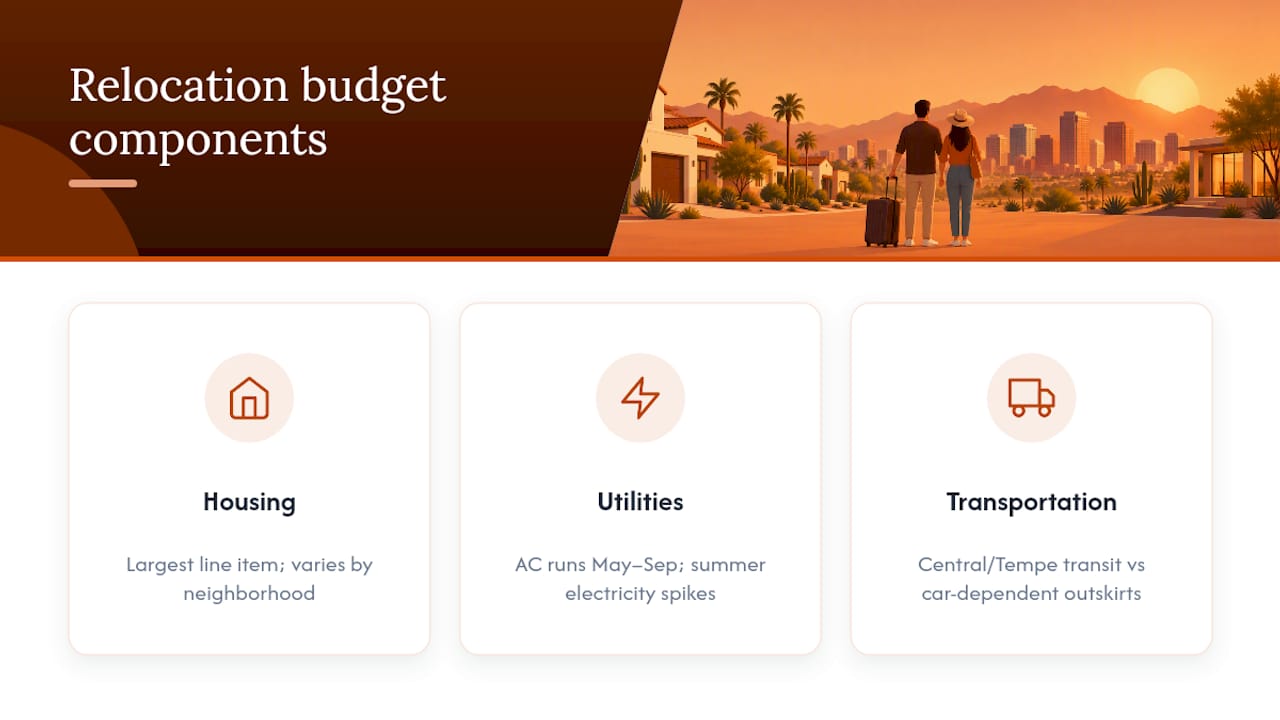
Housing is the largest line item, but it is not the only one that shifts sharply when you move to a desert climate. Electricity bills climb in summer because air conditioning runs almost constantly from May through September, and that seasonal swing is worth budgeting for separately from your baseline utility estimate.
Transportation costs depend heavily on which sub-area you choose. Central Phoenix and Tempe residents near the Valley Metro light rail line have a genuine transit alternative for some trips, while East Valley and West Valley commuters are largely car-dependent, which means factoring gas, insurance, and highway tolls on some corridors into your monthly numbers.
Groceries and everyday goods do not vary as dramatically by neighborhood as housing does, but proximity to major grocery chains and warehouse clubs is a real factor in West Valley and outer East Valley communities where the nearest full grocery store can be a longer drive than in denser Central Phoenix or Tempe.
When you build a relocation budget, treat housing, utilities, and transportation as three separate line items rather than folding them into a single “cost of living” guess. Phoenix’s desert climate and sprawl mean all three move independently of each other depending on where you land.
School districts and education options by neighborhood
Families relocating to Phoenix should treat school research as a parallel track to house hunting, not an afterthought. Arizona does not use a single citywide school district. Boundaries shift block by block, and two homes a few streets apart can feed into different elementary, middle, and high schools.
The Arizona Department of Education’s school report card portal is the primary tool for checking a specific school’s performance data and enrollment details before you commit to an address. East Valley communities in Chandler and Gilbert are frequently chosen by relocating families in part for their school reputations, while Scottsdale offers a mix of public and well-regarded private options. Central Phoenix and Tempe have more varied school quality block by block, which makes the report card lookup especially useful there.
Charter schools and open enrollment policies also mean you are not always locked into your neighborhood’s assigned school, so it is worth checking enrollment windows early, since some fill up months before a fall start date.
Safety and crime patterns to weigh by area
Safety varies as much by micro-market in Phoenix as cost does, and it is worth researching at the neighborhood level rather than relying on a citywide reputation. Suburban master-planned communities in the East Valley and West Valley generally report lower crime rates than some pockets of Central Phoenix and parts of West Phoenix, though individual streets and specific developments can differ from their broader area’s reputation.
Rather than relying on general impressions, cross-check a specific address against local police department crime mapping tools and talk to residents on neighborhood social platforms before signing a lease. This matters more in a spread-out metro like Phoenix, where “downtown Phoenix” and “Tempe near ASU” can have very different profiles just a few miles apart, and where a single citywide safety statistic tells you very little about your specific block.
Amenities and lifestyle factors that shape neighborhood desirability
Beyond cost and commute, day-to-day livability often comes down to parks, shopping, and cultural access, and Phoenix’s sub-areas differ sharply here.
Scottsdale offers resort amenities, golf, and upscale shopping corridors like Old Town. Tempe’s proximity to Arizona State University brings a younger, walkable scene with restaurants and entertainment concentrated near campus and Tempe Town Lake. Central Phoenix neighborhoods like Arcadia and Encanto-Palmcroft mix historic character with proximity to downtown’s museums, the Phoenix Art Museum, and Roosevelt Row’s arts district. East Valley and West Valley suburbs trade some of that density for larger community parks, newer shopping centers, and family-oriented recreation facilities.

None of these lifestyle factors show up in a median rent figure, but they are often what determines whether a neighborhood that fits your budget also fits how you actually want to live. A relocator who values walkable dining and nightlife will likely be unhappy in a West Valley subdivision, even if the numbers work better there, and the reverse is just as true for a family wanting a quiet cul-de-sac.
Handling Phoenix heat during your move and first days
Phoenix heat is not a background detail during a move. It is a scheduling and safety factor that deserves its own plan.
Load and unload trucks in the early morning hours, before the pavement and truck interior turn into an oven. Keep water on hand for yourself and anyone helping, and take breaks more often than you would in a milder climate. Confirm the AC is on and functioning at your new place before the truck arrives, not after, since a few hours without cooling in a Phoenix summer can be more than uncomfortable for pets, plants, and heat-sensitive electronics.

Give yourself a buffer day after the move before tackling unpacking in earnest. Trying to power through boxes in a hot garage or a home where the AC is still catching up from being off is a fast way to overheat and slow down the whole process. If you are using a furnished rental as your temporary base, you skip this problem entirely on arrival, since the unit is already climate-controlled and livable from day one.
Common relocation pitfalls specific to Phoenix
The most frequent mistake is choosing a house before validating the sub-area, then discovering the commute, school boundary, or HOA rules do not fit real life. Neighborhood-first planning exists specifically to prevent this.
The second is underestimating summer utility costs, particularly for a home with an aging AC unit or poor insulation, which can turn a comfortable rent or mortgage payment into a tight one for four or five months a year. The third is skipping HOA due diligence in the East Valley and West Valley’s many master-planned communities, where rental restrictions, reserve shortfalls, and a high concentration of short-term rentals can affect both your daily life and future resale value. Request HOA financials and rental policies before you sign, not after.
A fourth, smaller but common pitfall: moving during peak summer without booking carriers early enough, then facing limited availability or higher rates during the busiest relocation months.
Lessons learned and common mistakes to avoid
I have watched relocators fall in love with a floor plan and skip the commute test, only to discover a 25-minute drive turns into 50 during rush hour on Loop 101. I have also seen a family sign a lease in July without checking whether the AC had been serviced, and spend their first two weeks in a home that never quite cooled below 80 degrees.
The pattern is always the same: skip the neighborhood work, pay for it later. Start with the sub-area, use a temporary stay to confirm it, then commit.
— Sean
How Phoenix Furnished Rentals helps relocators

While you sort out which Phoenix sub-area fits your life, Phoenix Furnished Rentals offers move-in-ready lofts and apartments with fully equipped kitchens, in-unit laundry, workspaces, and flexible booking, without a 12-month lease tying you down before you’ve toured a single neighborhood. Options include various lofts and apartments designed for relocating professionals who need comfort and flexibility. Browse current available properties or reach out for help matching a stay to your relocation timeline.
Sources
FAQ
Where are AZ residents moving to?
Within Arizona, relocators commonly move toward East Valley cities like Chandler, Gilbert, and Mesa for family-oriented, newer housing, along with West Valley suburbs offering more space per dollar. Scottsdale and Tempe also draw steady interest for lifestyle and university proximity, respectively.
What salary is needed to live comfortably in Phoenix?
There is no single official figure for a “comfortable” salary, since it depends heavily on which sub-area, rental versus ownership, and household size you’re planning around. A useful starting point is the city’s median gross rent of $1,582 and median owner costs with a mortgage of $1,847, then layering in your own utility and transportation estimates.
Which city in Phoenix is considered the best to live in?
There is no single “best” sub-area. It depends on your priorities: East Valley suburbs like Chandler and Gilbert suit families chasing schools and space, Tempe suits those wanting walkability near Arizona State University, and Scottsdale suits buyers prioritizing resort-style amenities over affordability.
Is it better to live in Arizona or Florida?
This depends on personal priorities like climate preference, job market, and cost of living rather than a single correct answer, and this guide does not cover Florida housing data. For Phoenix specifically, expect a hot, dry desert climate with a median gross rent of $1,582 and a housing market spread across distinct sub-areas rather than one uniform city profile.