
If you need a place to live near HonorHealth John C. Lincoln Medical Center, start with a short list of questions. How long is your stay? Do you need a furnished unit? How far will you drive on shift days? Most people in this situation are travel nurses, new hires, visiting clinicians or families of patients. They need somewhere to live for a month or more, not a 12-month lease. This guide covers the area around the hospital, the commute reality, when to book, and the rules that decide what you can rent.
TL;DR
- The hospital sits at 250 E. Dunlap Ave. in north-central Phoenix, in the Sunnyslope area. Nearby apartments are the closest option, but furnished, short-term inventory there is thin.
- Phoenix is car-dependent. Judge a place by drive time at your shift hours, not by miles.
- October through April is peak season. Book winter stays months ahead.
- Stays of 30 nights or more are generally treated as mid-term rentals, which changes the paperwork and taxes compared with nightly bookings.
- We are in downtown Phoenix, not beside the hospital. Our furnished lofts suit people who want a walkable base and are fine with a drive.
Table of Contents
- Where the hospital is and what surrounds it
- What kinds of housing you will actually find
- Drive time beats distance
- Timing: Phoenix has a winter peak
- The 30-night line and why it matters
- Our view: what we tell nurses and hospital-bound guests
- Furnished monthly stays from downtown Phoenix
- A short checklist before you commit
- Patients and families
- FAQ
- Sources
Where the hospital is and what surrounds it
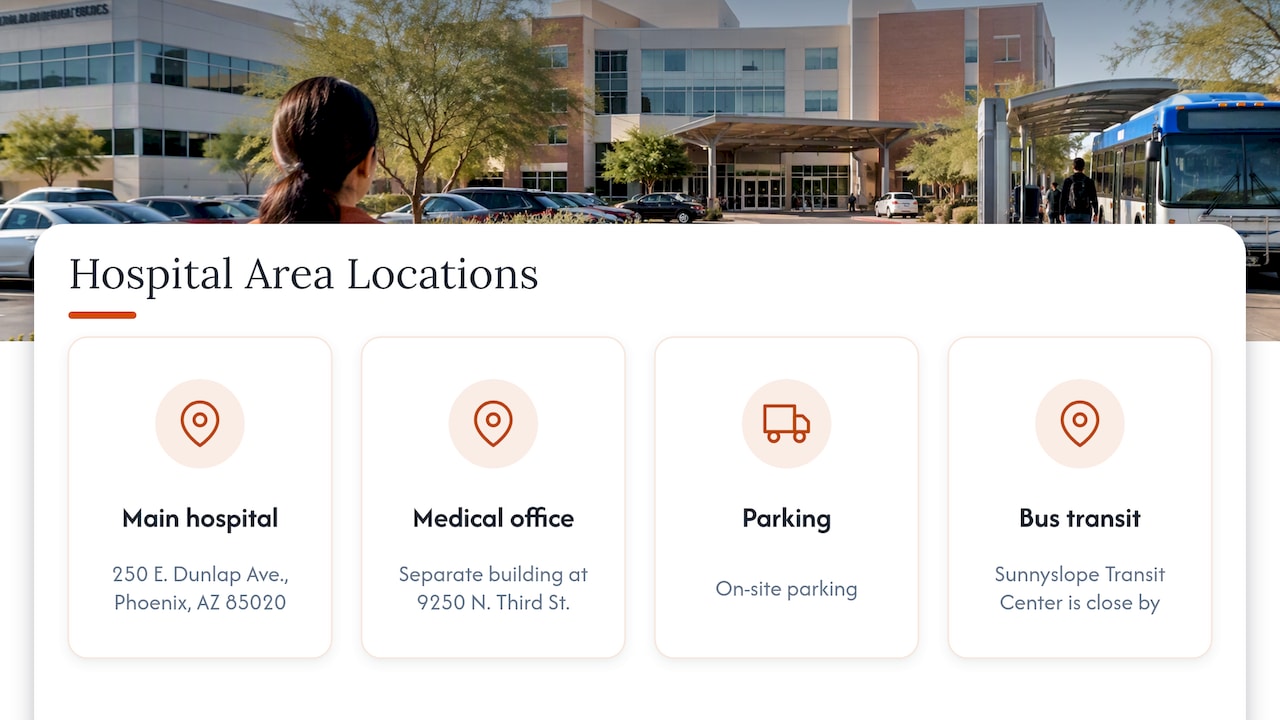
HonorHealth John C. Lincoln Medical Center is at 250 E. Dunlap Ave., Phoenix, AZ 85020. It is a Level 1 trauma center in north-central Phoenix, near Central and Dunlap avenues. Parking is on site, and the Sunnyslope Transit Center is close by for bus riders. The main hospital is open around the clock, and the campus map shows that outpatient and imaging suites sit in separate buildings, including a medical office building at 9250 N. Third St. Check which building your appointment or shift is in before you pick a street.
The surrounding neighborhood is Sunnyslope. It is a mature residential area. HonorHealth’s community health needs assessment describes the hospital as a long-standing presence in the surrounding community, with support for local amenities and affordable housing. For a visitor, that means established services, older apartment complexes and houses, and fewer of the new high-rise buildings you find in downtown.
What kinds of housing you will actually find
There are four realistic options near the hospital.
| Option | Best for | Trade-off |
|---|---|---|
| Unfurnished apartment near Dunlap and 7th Street | Staying a year or longer | Lease terms, deposits, and you supply every pot and pillow |
| Nightly vacation rental or hotel | A few nights, an emergency trip | Costs climb quickly past a week or two |
| Furnished monthly rental | 30 days to six months | Fewer units, and they book early in winter |
| Room or sublet from a private party | Tight budgets, flexible people | Little protection, uneven quality |
Unfurnished complexes close to the hospital are easy to find in any listing search. Those listings are built around 12-month leases. If your assignment is 13 weeks, a short lease usually carries a premium or is not offered at all. A furnished monthly rental is built for exactly that situation: you bring luggage, and the kitchen, bed, linens, WiFi and laundry are already there.
Drive time beats distance
Phoenix is spread out and almost everyone drives. Local practitioners advise checking commute in minutes at your actual shift times. The I-17 and SR-51 can slow down at peak hours, which matters if you work a rotation that starts at 6:30 a.m. or ends at 7 p.m. Source: College Rentals.
A practical way to test a location:
- Open a maps app and set a departure time that matches your first shift.
- Check the drive for a weekday, not a Sunday.
- Repeat for the return trip at shift change.
- Ask whether parking at the hospital is free for staff or visitors in your situation, and where you will park.
- If you have a choice, favor a location with a second route, so one backed-up freeway does not decide your morning.
From downtown Phoenix, you will be driving north on freeways or major surface streets. We are not going to claim a precise number of minutes, because it changes by hour. Test it yourself with your own schedule before booking.
Timing: Phoenix has a winter peak
Phoenix demand follows the weather. According to Night-Rate’s Phoenix pricing analysis, the busy stretch is the snowbird season from October to April, with January through March the strongest, and June through August the slow season, when rates fall to roughly 65 to 79 percent of peak. Spring training and golf events add pressure in February and March.
A Phoenix market report from Calibr8ted notes that travel nurses and seasonal visitors both shape the market, and recommends securing units three to six months ahead for peak winter months, since inventory tightens between November and March. The same report estimates that about 70 percent of annual short-term rental revenue lands in the October to April window.
What that means for you:
- Starting a contract between November and March: begin looking as soon as you have an offer. Do not wait until the week before.
- Starting in summer: you have more choice and often better rates, and a two to four week lead time is usually workable. Our own guide to booking monthly rentals by season goes through the lead times.
- Contract that crosses into winter: ask about rate changes at renewal, because a rate that is fair in September may not be available in January.
On broader rent trends, Institutional Property Advisors’ 2026 Phoenix multifamily report says rents softened in 2025 after a supply surge and points to stabilizing occupancy and modest growth in 2026, as new construction completions have fallen by roughly 40 to 50 percent from earlier peaks. Expect less room to negotiate than you would have had a year ago.
The 30-night line and why it matters
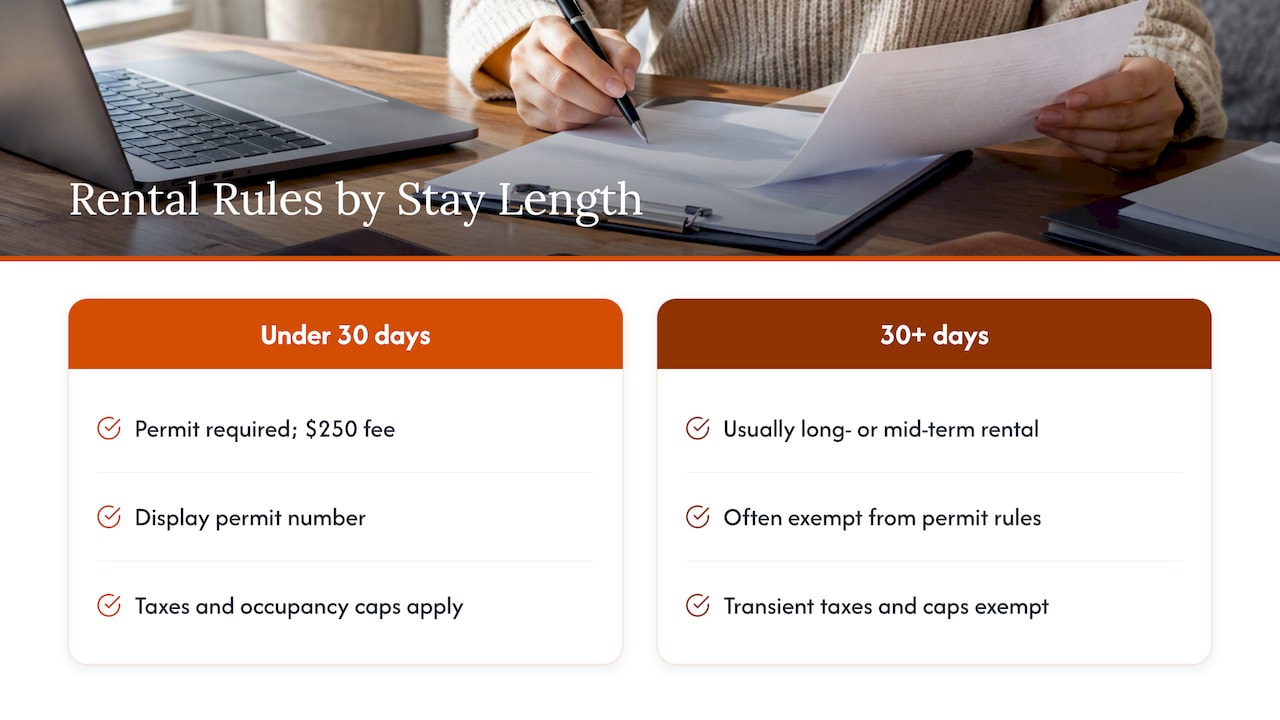
The length of your stay changes the rules. The City of Phoenix requires a permit for short-term rentals, with a registry page that explains the process. The permit costs a $250 non-refundable fee, listings must display the permit number, and operators must follow safety equipment rules and screen guests.
Stays of 30 days or longer are generally treated differently. UrbanMatter’s Phoenix comparison explains that these are usually handled as long-term or mid-term rentals, which exempts them from many of the short-term permit requirements, transient taxes and occupancy caps that apply to nightly bookings. Confirm the contract length before you sign, because the legal framework follows the contract. We explain the mechanics in our piece on how the 30-day cutoff shapes mid-term rentals.
For a traveler, the practical takeaway is simple. If you will be here a month or more, ask for a monthly rate and a monthly agreement. Pricing a 35-night stay as 35 nightly bookings is rarely the best deal.
Our view: what we tell nurses and hospital-bound guests
We run furnished lofts in downtown Phoenix, and many of our guests are traveling nurses, relocating professionals and corporate travelers. We are not going to pretend downtown is next door to every hospital. Here is how we think about the choice.
If your priority is the shortest possible walk or drive to the hospital, and you are comfortable with an apartment-style building in Sunnyslope, look there first and accept limited furnished supply. If your priority is a place you actually want to come home to after a 12-hour shift, with a full kitchen, in-unit laundry, a real workspace and restaurants within walking distance, downtown is a strong alternative. You trade some drive time for a neighborhood with something going on.
Three things we would tell any guest:
- Sleep matters more than miles. A quiet bedroom and blackout-friendly setup beat a shorter commute for people on nights.
- Ask what is in the kitchen. Our room-by-room amenities list shows what to demand in writing from any furnished rental, ours or anyone else’s.
- Settle the pet and parking questions before you book, not after you arrive.
The reasoning behind all of this is the same: a temporary home should reduce your stress, not add another task.
— Sean
Furnished monthly stays from downtown Phoenix
Our furnished lofts are built for stays from short trips to several months. Units include fully equipped kitchens, in-unit laundry, dedicated workspaces, WiFi and flexible booking policies, and some are pet-friendly. Pricing is shown at booking, so check the property page for the dates you need.
A few places to start:
- Roosevelt Row Loft, in the arts district, with restaurants and galleries close by.
- Phoenix Downtown Zen Loft, for guests who want a calmer, more minimal feel.
- Phoenix Muralist’s Loft, a good fit for people who like an art-filled space.
If your assignment is with a medical employer, our guides for travel nurses near St. Joseph’s and medical professionals near Mayo Clinic explain how we handle similar stays, and the medical relocation page for Roosevelt Row covers a longer move. If your employer or an insurer is paying, see how we get housing approved in writing.
A short checklist before you commit
- Confirm the stay length and the agreement type. Nightly versus monthly changes taxes and terms.
- Test the drive at your shift hours, both directions.
- Get the inventory in writing: kitchen items, linens, laundry, desk, internet.
- Ask about cancellation and extension. Contracts get extended or cut short. Our guide to furnished versus unfurnished costs helps you compare the full price of each path.
- Check pets, parking and noise. Each can break an otherwise good fit.
- Book early if you arrive between November and March.
Patients and families
If you are looking for a place because a family member is a patient, call the hospital’s social work or patient services team first. They know of lodging arrangements and sometimes discounts that are not advertised. Our page on where to stay near Phoenix hospitals explains why we suggest this step. The hospital’s main number is listed on its location page.
FAQ
Is there furnished housing within walking distance of John C. Lincoln?
The streets around Dunlap Avenue and 7th Street are mostly standard apartment complexes on 12-month leases. Furnished units are limited and tend to be booked early in winter. If you cannot find one, a furnished rental a short drive away is the usual solution. Test the commute at your shift hours before you decide.
When should I book for a winter assignment?
As early as you can. A Phoenix market report recommends three to six months ahead for peak winter months, with the tightest supply from November through March. For summer, a few weeks is often enough.
Does a 30-night stay change what I pay?
Often it does. Stays of 30 days or longer are generally treated as mid-term rentals, which exempts them from many short-term permit rules and transient taxes, according to UrbanMatter. Ask the host to confirm in writing which agreement applies.
Can I bring a pet?
Some of our lofts are pet-friendly, but policies differ by unit. Ask before booking and confirm any pet terms in the booking details. This applies to any rental, so do not assume.
Sources
- HonorHealth John C. Lincoln Medical Center
- HonorHealth John C. Lincoln campus map
- HonorHealth community health needs assessment
- College Rentals listing on Phoenix commuting
- Night-Rate: Airbnb Pricing in Phoenix
- Calibr8ted: Phoenix market report
- Institutional Property Advisors: Phoenix multifamily report
- City of Phoenix: Short-Term Rental Registry
- UrbanMatter: Vacation rentals in Phoenix and Scottsdale
Leave a Reply