
Corporate housing billing is usually simple on paper: one furnished home, one monthly rate, one invoice. The surprises come from the details around that rate: a prorated first month, a card surcharge, a cleaning or pet line, or a tax that applies to a 28-night stay but not a 31-night one. This guide walks through how an invoice for furnished temporary housing is built, who pays it, and what to check before you approve it, with Phoenix specifics where they matter.
TL;DR
- Corporate housing is typically a furnished home rented for 30 days or longer, with utilities, internet and housewares bundled into one monthly rate, and the payer can be an employer, a relocation agency or the occupant.
- If you move in on any day other than the first of the month, expect a prorated first charge. Ask how the daily rate is calculated before you sign.
- Payment method changes cost: ACH is often free, while cards can carry a surcharge. Ask for the fee in writing.
- In Arizona, the 30-day line matters for tax. Stays under 30 days are treated as transient lodging, while long-term stays of 30 days or more are handled differently since January 1, 2025.
- Before approving any invoice, match it line by line to your agreement: rate, dates, deposit, cleaning, pets, parking and taxes.
Table of Contents
- What corporate housing billing actually covers
- Anatomy of a monthly invoice
- How the first month is calculated
- Payment methods and processing fees
- Arizona taxes: why the 30-day line matters
- What to check on an invoice, by traveler type
- An invoice review checklist
- Our perspective: what good billing looks like
- Book a furnished loft in Downtown Phoenix
- FAQ
- Sources
What corporate housing billing actually covers
Corporate housing is furnished temporary housing. Hostfully’s 2026 guide describes the common model as a fully furnished home rented for 30 days or longer, with utilities, internet and housewares included in one monthly rate. The party paying may be an employer, a relocation agency or the person living there.
That last point shapes the billing. Three setups come up most often:
| Who pays | How it usually works | What to watch |
|---|---|---|
| Employer | The company is billed monthly and the traveler never sees the invoice | The invoice must carry the right company name, PO number or cost center |
| Relocation agency or insurer | The invoice goes to the agency, often with written approval of dates and rate first | Approved dates and the invoice dates must match exactly |
| The occupant | You pay by card or bank transfer and may seek reimbursement | Keep every receipt in the format your employer requires |
The agreement itself usually runs from 30 days to a year, with extensions negotiated as an assignment runs long, according to the same Hostfully guide. In billing terms, that means two documents matter: the agreement (what was promised) and each invoice (what is being charged against it). Your job is to make sure they agree.
If you are still deciding between a furnished loft and a traditional corporate unit, our comparison of monthly rentals and corporate housing covers the structural differences. For a provider-side view of what a 30-plus-day stay should include, see our checklist for business travelers.
Anatomy of a monthly invoice
A clean corporate housing invoice has a handful of lines. When it has twenty, ask why.
The base rate
This is the monthly (or nightly) rate for the home. In a bundled model it already includes utilities, Wi-Fi and housewares. Confirm in the agreement that this is true, and ask whether there is a cap on electricity in the hot months. Phoenix summers push cooling costs up, so a bundled rate with no cap is worth more than an “all utilities extra” one that looks cheaper in April.
One-time charges
These appear on the first invoice only:
- Security deposit. Refundable, and the agreement should state when and how it comes back.
- Cleaning fee. Some providers charge it once at move-out, others fold it into the rate.
- Administrative or booking fee. Not universal. If present, it should be named and fixed.
- Pet fee or pet rent. If you are bringing an animal, check whether it is one-time, monthly, or both. Our page on pet-friendly midterm rentals for corporate travelers explains what to ask.
Recurring add-ons
Parking, an extra occupant, premium cleaning visits or a second key set. Each should be listed separately with its price per month. An add-on that appears on invoice three but not in the agreement is a billing error until proven otherwise.
Taxes
Taxes depend on the length of stay and the state. We cover Arizona below, because it changes what a 25-night and a 35-night stay cost on paper.
How the first month is calculated
The most common source of confusion is the first invoice. Most billing systems charge a prorated amount if a resident moves in on any day other than the first of the month. The Infor property management help page documents that behavior for its system. Corporate housing providers use different software, so the exact method varies, but the principle is the same.
Here is a worked example with made-up numbers, purely to show the arithmetic. Say a monthly rate is $3,000 and you move in on the 11th of a 30-day month:
- Days occupied in that month: 20 (the 11th through the 30th).
- Daily rate if prorated by calendar days: $3,000 ÷ 30 = $100.
- First partial-month charge: 20 × $100 = $2,000.
- From the 1st of the next month, you pay the full $3,000.
Three things can change that result, so ask about each:
- Which divisor is used. Some providers divide by the actual days in the month, others by 30 or 365-based formulas. In a 31-day month, that shifts the daily rate.
- Whether billing runs anniversary to anniversary. Many corporate stays bill from move-in date to the same date next month, which avoids proration entirely. Both are legitimate, but you need to know which one applies.
- How the last month works. If you leave on the 14th, are you charged by the day, or the full month?
Extended assignments that run past the original end date add another wrinkle: do you keep the original rate or move to a new one? Providers who think carefully about length of stay often price longer commitments differently, a logic explained in this piece on minimum stay pricing. Ask upfront what the rate will be if your assignment is extended by a month or two, and get the answer in writing.
Payment methods and processing fees
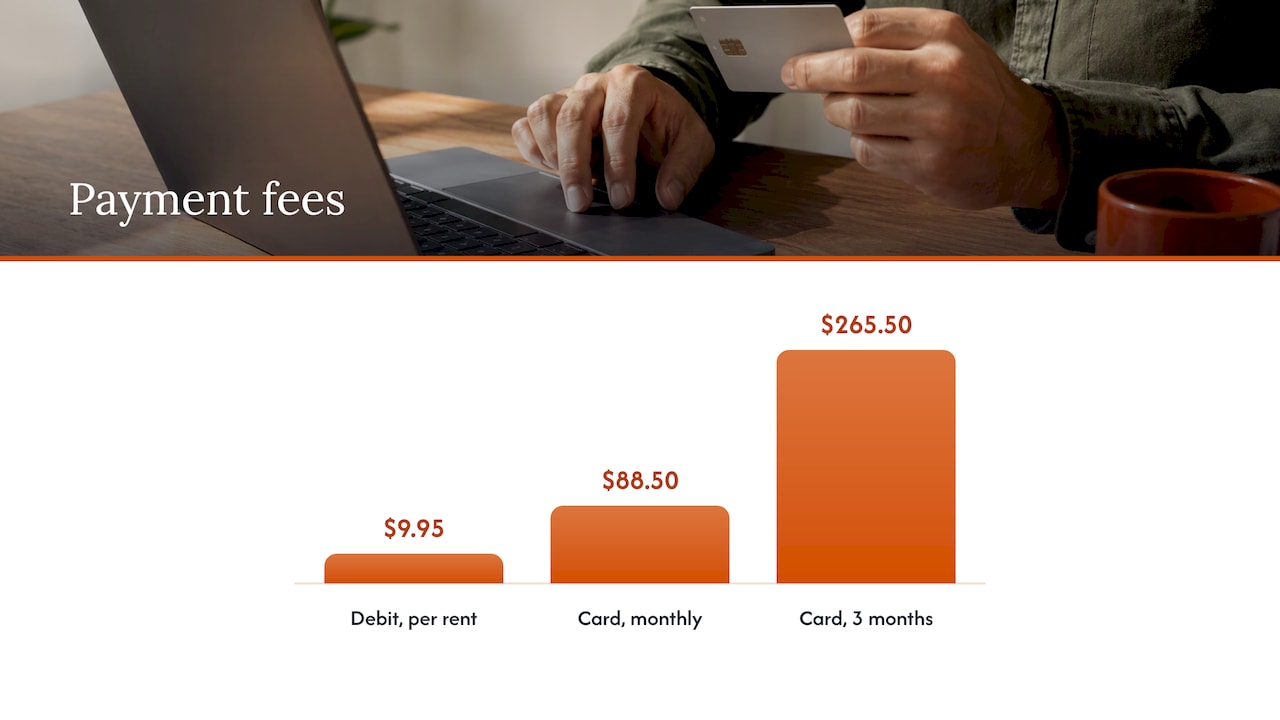
How you pay can add to what you pay. Zillow’s rent payment help page is a useful benchmark, because it shows the range of costs common in US rent payments: ACH is free, debit fees are $9.95 for rent, and credit-card fees are 2.95% (page published 2024). That is one platform’s schedule, not a rule for corporate housing, but it illustrates the pattern: bank transfer is cheapest, cards cost more.
On a $3,000 monthly charge, a 2.95% card fee is $88.50 each month, or $265.50 over a three-month assignment. Not nothing. A few practical points:
- Employers paying by ACH or wire avoid card fees entirely, and many finance teams prefer it for audit trail reasons.
- Travelers paying by card should ask whether the fee applies to the deposit too.
- Corporate cards sometimes earn rewards that offset the fee. Do the math before assuming they do.
- Receipts. Ask for an itemized receipt each month showing payment method and any fee, so expense reports match.
At Phoenix Furnished Rentals, guests complete payment for their stay through our online booking platform. For the specific payment options and any fees on a given booking, check the details shown at checkout or ask our team before you reserve.
Arizona taxes: why the 30-day line matters
Tax is where a short stay and a mid-term stay diverge. Under Arizona’s transaction privilege tax (TPT), transient lodging stays of fewer than 30 days must be collected and remitted under the transient lodging or hotel classification, according to the Arizona Department of Revenue. For longer stays, the rule changed recently: as of January 1, 2025, residential rental property owners are no longer required to collect or remit city TPT on long-term lodging stays of 30 days or more, per A.R.S. § 42-6004 (H).
In practice, that means:
- A 28-night stay in Phoenix is likely to show lodging taxes on the invoice.
- A 30-night or longer stay may not show the same city tax lines, depending on how the provider is classified and the property type.
- A booking that gets extended past 30 days, or one cut short below it, can change the tax treatment of the whole stay. Ask how the provider handles that.
Other states differ. As Avalara notes, lodging-tax rules vary significantly by jurisdiction, and stays of 30 days or more may be exempt depending on the state. If your employer is reimbursing you for a stay outside Arizona, do not assume the Phoenix treatment travels with you. For tax questions that affect your company’s books, your finance team or a tax professional is the right person to confirm treatment. The invoice is only as accurate as the provider’s classification.
The 30-day threshold is also why we wrote about how it reshapes U.S. mid-term rentals in Phoenix.
What to check on an invoice, by traveler type
Corporate travelers and business professionals
Your finance department cares about format. Confirm the invoice names the legal entity, lists the stay dates, shows the unit address, and separates rent from deposits and taxes. If your company uses purchase orders, supply the number before the first invoice, not after. Our guide to corporate lease requirements in Phoenix covers the paperwork employers typically ask for.
Relocating professionals
You may be paying out of pocket for a month or two while a home purchase or lease is arranged. Ask about the cost of extending by a few weeks, and whether a notice period applies if your house closes early. Reading the budget range for Phoenix corporate housing helps you sanity-check what a fair monthly total looks like.
Travel nurses
Contract lengths are often fixed blocks, so date alignment matters most. Match the lease start and end to your assignment, and ask whether a cancelled or shortened contract triggers any fee. If your hospital is near downtown, our page on housing near Abrazo Heart Hospital shows how nightly and monthly stays compare.
Insurance-funded stays
If your stay follows a fire, flood or other covered loss, the insurer typically approves the housing, dates and rate before paying. Get that approval in writing and make sure the invoice matches it. We explain the process in our guide to Phoenix ALE housing.
Snowbirds and winter visitors
Seasonal stays of three to five months bill like any other monthly stay, but the questions differ: is the rate fixed for the whole season, is a deposit held across months, and what happens to utilities if you leave for a week over the holidays? Ask whether the rate holds if you extend into spring, and whether a pet changes the monthly total. Booking early matters for winter demand; our note on when to book a monthly rental explains the timing.
An invoice review checklist
Run every invoice through these seven questions before you approve it:
- Do the dates match the agreement? Move-in, move-out and any extension.
- Is the base rate the agreed rate? Check proration on the first and last invoice.
- Are utilities and internet really included? Any separate utility line needs a basis in the agreement.
- Is each one-time charge labeled? Deposit, cleaning, pet and admin fees should be named.
- Are taxes shown and plausible for the stay length? Compare against the 30-day rule above.
- Is there a payment fee? Compare it with what you were told.
- Is the payer correct? Company name, billing contact, reference numbers.
If an item fails any of these, ask for a corrected invoice rather than paying and disputing later. Reimbursement departments are slow to accept an invoice that needs an explanation.
Our perspective: what good billing looks like
We operate furnished lofts in Downtown Phoenix, and most billing questions we hear come down to one thing: people want to know the full cost before they commit, not after. A nightly rate that looks low and a monthly total that surprises you do not serve anyone.
Our view is that a furnished stay should be priced around what you actually need: a kitchen you can cook in, laundry in the unit, a workspace, Wi-Fi and a comfortable place to sleep. The point of choosing furnished housing over a lease is that you skip the setup costs and the long commitment. A bill that adds back a dozen small fees defeats that.
So our advice is the same whether you book with us or anyone else: ask for the total, ask what is excluded, and ask what happens if your dates move. Ask for the inventory too. Our room-by-room amenities list shows what you should expect to see in a furnished unit, which tells you what the rate is meant to cover.
— Sean
Book a furnished loft in Downtown Phoenix
If you are planning a stay of a few nights, a few months or a full winter, you can see our lofts, including the Roosevelt Row Loft, the Downtown Zen Loft and the Muralist’s Loft, on our properties page. Each is fully furnished with an equipped kitchen, in-unit laundry, a workspace and WiFi, and we offer flexible booking policies and monthly options. We do not publish rates in this article, so check the property page for current availability and pricing, or ask us anything about billing before you book.
FAQ
How is corporate housing usually billed?
Most providers issue a monthly invoice with one bundled rate covering rent, utilities and housewares. The invoice goes to whoever is named as payer: the employer, a relocation agency, an insurer or the occupant. One-time items like deposits and cleaning fees appear on the first invoice.
Will I be charged for a partial month?
Usually yes, if your move-in date is not the first of the month. Some systems prorate the first month by the day, as Infor’s documentation describes for its software, while other providers bill from your move-in date to the same date the next month. Ask which method applies before you sign.
Are there extra fees for paying by credit card?
Sometimes. Fees depend on the provider and the payment platform. As one benchmark, Zillow’s schedule lists ACH as free and credit cards at 2.95%. If your employer is paying, bank transfer usually avoids the fee altogether.
Is corporate housing taxed in Arizona?
It depends on the length of stay. Stays under 30 days fall under Arizona’s transient lodging tax classification, and as of January 1, 2025, owners are no longer required to collect or remit city TPT on long-term lodging stays of 30 days or more. For your own situation, confirm with your finance team or a tax professional.
How long can I stay in corporate housing?
Agreements typically run from 30 days up to a year, and extensions are negotiated as assignments run long. If you think your stay might grow, ask upfront how the rate and tax treatment would change.
Sources
- What Is Corporate Housing? A Guide for Property Owners (Hostfully)
- Prorate Move-In Charge Calculation (Infor)
- What forms of payment can I use and are there any fees? (Zillow)
- Residential Rental Guidelines (Arizona Department of Revenue)
- Corporate housing and lodging tax (Avalara)
- Minimum stay strategy (RM Hospitality)