
The best Phoenix neighborhoods for pet owners are the ones where your dog can get outside daily without a car: Downtown and Roosevelt Row for walkable, urban living, and Arcadia for canal paths, mature trees and bigger yards. Which one fits depends on your dog’s size, your budget, and whether you want a lease or a flexible furnished stay while you settle in. This guide covers the neighborhoods, the dog parks, the lease terms to check, and the heat rules that shape every Phoenix summer day.
TL;DR
- Downtown Phoenix has the highest Walk Score in the city (85), which makes it the easiest area to run daily dog errands on foot, with a dog park at Margaret T. Hance Park.
- Roosevelt Row pairs walkable patios and murals with Downtown access; Arcadia suits owners who want canal walks and yards.
- Arizona caps total refundable deposits, pet deposits included, at 1.5 times monthly rent. Assistance animals are not pets and carry no pet charges.
- Phoenix closes city trails to dogs at 100 degrees and above, so shade, early mornings and indoor space matter as much as the neighborhood.
- If you are relocating and want to test an area first, a furnished pet-friendly monthly loft lets you live there before you commit to a lease.
Table of Contents
- What makes a Phoenix neighborhood good for pets
- Downtown Phoenix: the most walkable base
- Roosevelt Row: art, patios and walkable dog routines
- Arcadia: canal paths and bigger yards
- Beyond the city line: Tempe and Scottsdale
- Neighborhood comparison at a glance
- Phoenix rules every dog owner should know
- Renting with a pet in Phoenix: what to check in the lease
- How to compare pet policies and outdoor space
- Our perspective on living with a dog in Downtown Phoenix
- Try Downtown with your dog in a furnished loft
- A sample week: a dog’s routine in Downtown and Roosevelt Row
- Who each neighborhood suits best
- FAQ
- Sources
What makes a Phoenix neighborhood good for pets
A pet-friendly neighborhood is more than a dog park nearby. Local real estate writers describe the full picture as parks and trails, walkability, pet-loving businesses, nearby vet and grooming services, and homes whose HOA or landlord rules actually allow pets. That last item is where many renters get caught: a street can look ideal and the building can still cap you at one small dog.
In Phoenix, one more factor outweighs the rest: heat. For a good part of the year, the practical question is not “how big is the park” but “can I get my dog outside before 8 a.m., and is there somewhere cool to go afterward?” A walkable block with shade and indoor dog-friendly stops beats a large park you can only use in January.
Here is the checklist we use when we talk to guests about choosing an area:
- Short walks to relief areas. Grass, a tree-lined block or a park within a few minutes of the front door.
- A real dog park. The city maintains 12 dedicated dog parks among its 186 parks, so they are scarce enough that location matters.
- Patios and shade. Dog-friendly restaurants and covered walks let you get out in the shoulder hours.
- Vet and grooming access. Know your nearest emergency vet before you need one.
- Building policy. Breed, weight and number-of-pets limits, and what the fees are.
Downtown Phoenix: the most walkable base
Downtown Phoenix has a Walk Score of 85, the highest of any Phoenix neighborhood, with Garfield (79) and Coronado (73) also rated very walkable. For a dog owner, that number translates into something concrete: several short walks a day instead of one car trip to a park.
The anchor for dogs is Margaret T. Hance Park. CityDog Phoenix describes two fenced areas, split for small and large dogs, with grass and decomposed granite, shaded benches and a Culver Street address, right next to Roosevelt Row’s restaurants. Water fountains can be unreliable in summer, so carry your own.
What Downtown does well:
- Short, frequent walks without driving.
- Dog park access in the urban core, not the suburbs.
- Restaurants, galleries and events within walking distance, many with patios.
- A good fit for people who work remotely, travel for work or are between homes.
What to weigh: Downtown is more concrete than leafy. Hot pavement is a real concern for paws in warm months, and apartment-style buildings often have weight or breed rules. If your dog needs a private yard, look further out.
Roosevelt Row: art, patios and walkable dog routines
Roosevelt Row is the arts district on the north edge of Downtown, and local agents point to it alongside Downtown for walkable access to amenities, parks and cultural sites. It is a good match for a dog that enjoys being out among people: murals to look at, coffee stops, and Hance Park within walking range.
This is also where our lofts sit. If you want to see how a dog-friendly day works here, we wrote a longer piece on walkable Roosevelt Row pet lofts. Lofts suit dogs that are comfortable in a single open space and owners who exercise them outside the home. A high-energy dog that needs a backyard will likely be happier elsewhere, and we would tell you that up front.
Arcadia: canal paths and bigger yards
Arcadia is the classic pick when a yard is the priority. Local sources describe Arizona Canal walks, dog-friendly patios, mature trees and large lots. Its walkability includes scenic routes like the Arizona Canal Path and the Indian Bend Greenbelt, which give dogs long, flat routes with more shade than a typical city sidewalk.
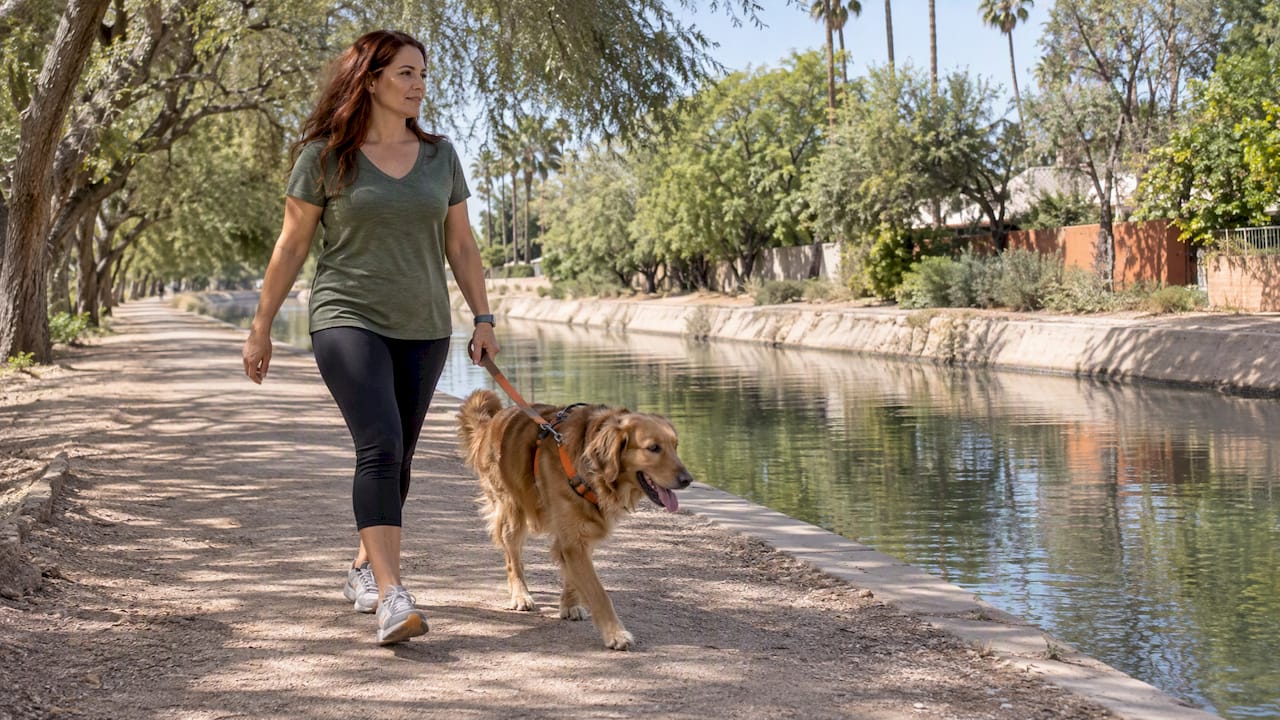
The trade-off is that Arcadia is more car-dependent for daily errands than Downtown, and its housing skews toward single-family homes. That suits owners buying or signing a long-term lease and less so someone arriving for a three-month work assignment.
Beyond the city line: Tempe and Scottsdale
Many people searching for Phoenix pet housing end up looking across city boundaries. Tempe has dog-friendly parks such as Papago Park, Mitchell Park and Jaycee Park, folded into broader community facilities rather than standing alone as dog parks. In a 2025 ranking of pet-friendly cities, Scottsdale placed first in Arizona, with Phoenix at 18, so the wider Valley is well served. Phoenix itself stays more affordable to test for a month, and commuting between these areas is easy once you have a car.
Neighborhood comparison at a glance
| Area | Best for | Daily dog routine | Watch out for |
|---|---|---|---|
| Downtown Phoenix | Walkability, short stays, remote workers | Short walks, Hance Park dog park | Hot pavement, building size limits |
| Roosevelt Row | Social dogs, patios, arts district | Walks to patios and murals, park nearby | Limited private outdoor space |
| Arcadia | Yards, canal walks, long-term living | Canal Path, Indian Bend Greenbelt | Car needed, mostly houses |
| Tempe | Park variety, university-area energy | Papago, Mitchell and Jaycee parks | Separate city, different rules |
Phoenix rules every dog owner should know
Leashes and licenses
Under the Phoenix City Code, dogs may not run at large. Off your own property, a dog must be on a leash no longer than six feet and under your control, and dogs over three months old must wear a collar or harness with a valid license tag. The leash requirement does not apply inside areas designated as dog parks.
Heat and your dog
Phoenix has gotten stricter here. The City Council approved an update to its animal cruelty ordinance in June 2026 that bars restraining dogs outdoors during extreme weather, including temperatures above 100 degrees, heat advisories, monsoon activity or dust storm warnings. Read the city’s page for the final text before you rely on the details.
For trails, the city’s Heat Safety Program says dogs are prohibited on city hiking trails when temperatures reach 100 degrees or warmer. During Extreme Heat Warnings, restricted trails are closed from 8 a.m. to 5 p.m.
Practical effects on where you live:
- Choose a place where you can walk before sunrise without driving.
- Make sure your building has a cool indoor space and, ideally, shaded outdoor paths.
- Never leave your dog tied or confined outdoors on a hot day, whatever the thermometer says at that moment.
- Plan winter, when Phoenix is mild, as your main season for long hikes and park days.
Renting with a pet in Phoenix: what to check in the lease
This is the part that costs money if you skip it. Arizona law, A.R.S. § 33-1321, caps total refundable security deposits, pet deposits included, at 1.5 times the monthly rent. The same source advises renters to confirm that any nonrefundable pet fee is identified as such in writing. A summary of Arizona law notes that landlords may charge nonrefundable pet fees if the purpose is stated in writing, and pet rent has no statutory cap. That same summary says lawful deductions from a deposit must be itemized and any balance returned within 14 business days after move-out.
Before you sign anything, ask:
- Is the fee refundable, nonrefundable, or monthly pet rent? Get each in writing.
- What are the limits? Number of pets, weight, breed.
- What happens at move-out? Who inspects, and what counts as damage?
- Are there pet-specific rules? Designated relief areas, leash rules in common areas, noise.
- Is cleaning included in your price or charged separately?
Assistance animals are different
If you have an assistance animal, Phoenix guidance is clear: assistance animals are not pets, and pet deposits, pet rent, pet fees and insurance are not allowed. If you believe you are being charged improperly, the City of Phoenix’s Equal Opportunity Department is the place to start.
We go deeper on the money side in our guide to pet-friendly monthly rentals, deposits and rent and on transparent pet policies for mid-term furnished rentals.
How to compare pet policies and outdoor space
Two homes with the same rent can be very different for a dog. Compare them on this short list:
- Walk to green space: time it on foot, with your dog, not on a map.
- Surface and shade: concrete and gravel get hot; ask where the shaded route is.
- Floor and layout: hard floors are easy to clean; open layouts give dogs room to move.
- Neighbors and noise: a barker in a shared building can become a lease problem.
- Laundry and kitchen: in-unit laundry makes dog bedding and towels a non-issue.
Visit at the hour you will actually walk. A block that feels pleasant at 7 p.m. in January tells you little about a July morning.
Our perspective on living with a dog in Downtown Phoenix
We run furnished lofts in Downtown Phoenix and Roosevelt Row, and a lot of our guests are people who arrive with a dog and no idea where they will end up living. Most are on a work assignment, relocating, or in between homes. What we see is that the right neighborhood is often the one you can try before committing.
Three things we tell pet owners:
- Live in the area for a month first. Walk the same routes at 6 a.m., at noon and in the evening. You will learn more than from any ranking.
- Ask about pets before you fall in love with a place. Policies differ unit by unit, so confirm the terms for the specific loft in writing.
- Plan the dog’s day around the heat, not the other way around. Early walks, a cool home and a nearby park or patio are worth more than square footage.
A furnished stay also removes a quiet source of stress: you do not have to move furniture, set up utilities or sign a 12-month lease to find out whether your dog likes the neighborhood.
— Sean
Try Downtown with your dog in a furnished loft
If you are relocating, on assignment, or just want a few months in the heart of the city, our furnished lofts in Downtown Phoenix and Roosevelt Row come with fully equipped kitchens, in-unit laundry, workspaces and WiFi, with pet-friendly options. You can browse our lofts and apartments and confirm the pet terms for the one you pick before you book.

For owners traveling for work, our page on Phoenix midterm rentals with pet-friendly policies explains how longer stays work, and our Roosevelt Row Loft puts you steps from the arts district. If you are still deciding between formats, this loft versus apartment comparison lists five questions to ask on a tour.
A sample week: a dog’s routine in Downtown and Roosevelt Row
Neighborhood rankings are abstract until you picture a day. Here is how a typical routine works for an owner living in the urban core, built around the heat rules above.
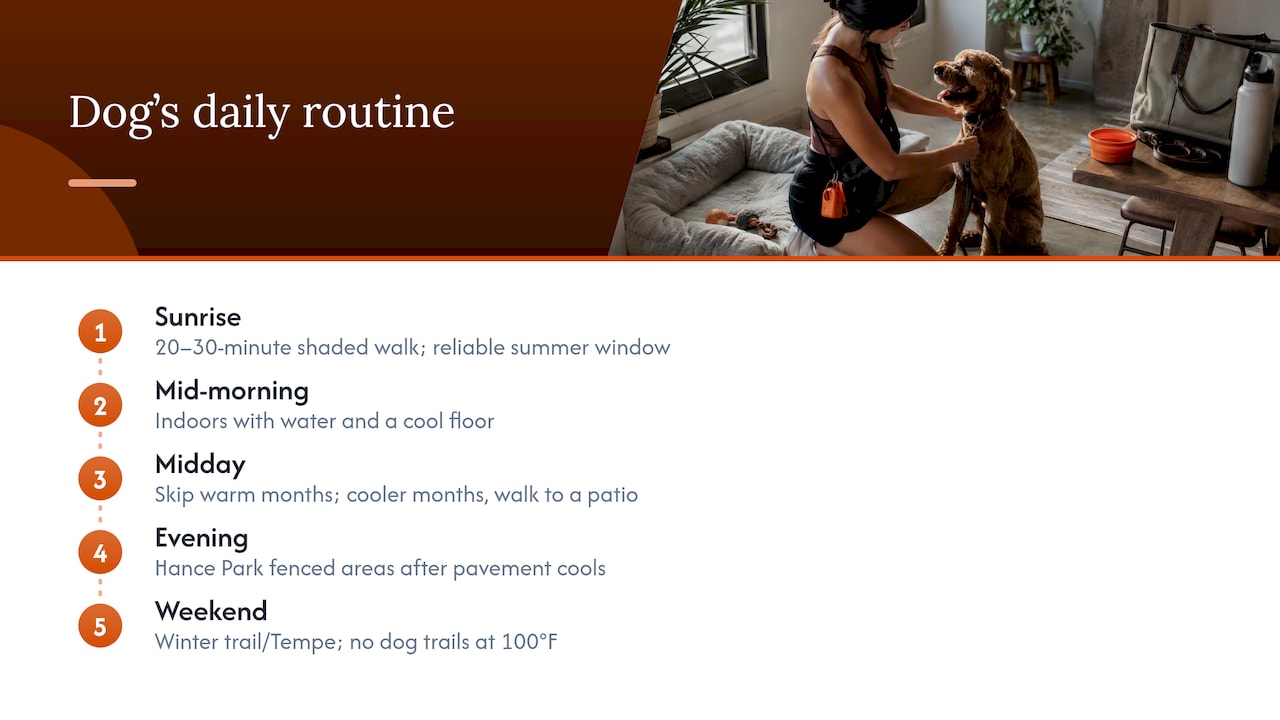
Early morning (around sunrise). A 20 to 30 minute walk on shaded blocks. This is the one reliable window in summer, and in winter you can stretch it. Leash up, license tag on, and check the forecast before you leave.
Mid-morning. Back indoors with water and a cool floor. If you work from home, this is when a workspace in the unit pays off: you stay close to your dog without having to leave the apartment.
Midday. Skip it in warm months. In cooler months, a walk to a patio for lunch works well in a walkable area, since you leave the car at home.
Late afternoon or evening. A trip to Hance Park’s fenced dog areas once the pavement has cooled. Bring your own water, since fountains can be unreliable.
Weekend. In winter, take the dog to a trail within the heat limits, or head to a park in Tempe. In summer, keep outings short and early, and remember that city trails can be off-limits to dogs once temperatures hit 100 degrees.
The routine shows why the walkable urban core works: every stage of the day can happen on foot, and none of it depends on a car being cool enough to drive.
Who each neighborhood suits best
- Travel nurses and contract workers with a dog. You need a short commitment, fast move-in and a home that does not require buying furniture. Downtown’s walkability helps you build a routine quickly. Our housing near the Phoenix Art Museum page covers furnished, pet-friendly stays in that corridor.
- Relocating professionals. Use a one- to three-month furnished stay to explore Arcadia, Tempe and Downtown on weekends, then choose a long-term lease with real information. Our piece on furnished versus unfurnished rentals helps you weigh the costs.
- Winter visitors with a small dog. Downtown or Roosevelt Row gives you a car-light season, with pleasant temperatures for the long walks that summer rules out.
- Families with a large, active dog. Arcadia or another yard-first area is usually the better fit, and a loft is best as a short bridge while you search.
FAQ
What is the most pet-friendly neighborhood in Phoenix?
It depends on what you value. Downtown Phoenix and Roosevelt Row are strongest for walkability and access to the Hance Park dog park, while Arcadia is favored for canal paths, mature trees and larger yards. Match the neighborhood to your dog’s energy and size, then confirm the building’s pet policy.
Can a landlord charge a pet deposit in Phoenix?
Yes, for pets, within limits. Arizona caps total refundable deposits, pet deposits included, at 1.5 times the monthly rent, and nonrefundable pet fees should be identified in writing. Assistance animals are not pets, so pet deposits, pet rent and pet fees do not apply to them.
Do Phoenix dogs need to be on a leash?
Yes. Outside your own property, a dog must be on a leash of no more than six feet, and licensed dogs wear a tag on a collar or harness. Designated dog parks are the exception, since they allow off-leash play inside their fences.
Can I walk my dog on Phoenix trails in summer?
Not when it is hot. The city prohibits dogs on its hiking trails when temperatures reach 100 degrees or warmer, and restricted trails close from 8 a.m. to 5 p.m. during Extreme Heat Warnings. Check the city’s heat safety page for current conditions before heading out.
Sources
- The Most Pet-Friendly Neighborhoods in the Phoenix Metro
- Best Walkable Neighborhoods in Phoenix (Redfin)
- Walkable Phoenix Neighborhoods for Food and Culture
- Phoenix Parks and Recreation Annual Report 2023
- Hance Park dog park (CityDog Phoenix)
- Arcadia neighborhood overview
- Phoenix Dog-Friendly Neighborhoods 2026
- Phoenix City Code, Sec. 8-14
- City Council approves updates to animal cruelty ordinance
- Heat Safety, City of Phoenix
- Phoenix Trail Heat Safety Program
- Creating Pet-Friendly Rental Policies in Phoenix, AZ
- Arizona Pet and ESA Laws
- City of Phoenix Assistance Animals brochure