
For short and mid-term furnished rentals, rental house rules are the guest-facing requirements you accept the moment you book, not fine print you can negotiate later. The five that matter most are occupancy limits, quiet hours, smoking policy, pet policy, and checkout time. Every one of these should already be visible on the listing page, the booking confirmation, and a pre-arrival message before you ever touch a key.
TL;DR:
- The five most critical rental rules are no parties, no indoor smoking, no unregistered overnight guests, quiet hours, and a clear checkout time, with violations likely leading to charges.
- Enforcement varies depending on whether you booked through platforms like Airbnb or Vrbo, or directly with the host, often involving warnings, fees, or reservation termination.
- To avoid disputes, always review house rules listed on the property page, confirmation email, and pre-arrival messages before booking and keep screenshots as proof.
- Making temporary, reversible changes to furnishings is usually allowed, but permanent alterations or moving furniture without permission can trigger fees or reset charges.
- In emergencies, call 911 for safety issues first, then contact the host or local authorities while keeping receipts and documentation to support your case in disputes.
Table of Contents
- What Are the Essential Rental House Rules Guests Should Expect?
- How Do Hosts Actually Enforce These Rules?
- Where Do You Find the Rules Before You Book?
- What Should You Do If Something Goes Wrong?
- A 60-Second House Rules Template You’ll Recognize
- How Phoenix Furnished Rentals Handles Guest Rules
- Can You Change Decor or Rearrange Furniture During Your Stay?
- What Happens in an Emergency During Your Stay?
- What Actually Happens When You Break a Rule?
- The Rules That Actually Protect You, Not Just the Host
- Ready to Book a Furnished Rental With Rules You Can Actually Trust?
- Sources
- FAQ
What Are the Essential Rental House Rules Guests Should Expect?
Most furnished rentals stick to a tight list, usually 8 to 15 items, because long, vague rule sheets confuse guests and actually lower compliance. Here’s what that shortlist typically covers and how it’s usually worded.
- Check-in and checkout: Standard checkout is 11 AM, check-in is 3 or 4 PM. Late checkout past the grace period (often 30 to 60 minutes) can trigger a fee, sometimes $25 to $50 per hour, and you generally need to request it in writing beforehand.
- Occupancy and visitors: A unit rated for two guests won’t legally or practically fit six. Daytime visitors are usually fine if you mention them; unregistered overnight guests are the fastest way to trigger a warning or fee.
- Quiet hours: Typically 10 PM to 8 AM. “Disturbance” usually means loud music, amplified sound audible outside the unit, or noise complaints from neighbors, not normal conversation.
- Smoking and vaping: Indoor smoking is almost always banned outright, including vaping and cannabis. Outdoor smoking may be allowed in a specific area, and violating the indoor ban commonly triggers a remediation fee for ozone treatment or deep cleaning.
- Pets: Some units allow pets with a flat fee ($50 to $150) or a weight and breed limit; others ban them entirely. Even pet-friendly units often restrict pets from beds or upholstered furniture.
- Parking, trash, and pool access: Assigned spot versus street parking, trash and recycling pickup days, and pool or hot tub hours (often no glass, no underage swimming without supervision).
- Off-limit areas and lost keys: Locked owner closets or storage rooms stay off-limits, and a lost key or fob replacement typically runs $25 to $100.
The five most consequential rules to get right are no parties or events, no indoor smoking, no unregistered overnight guests, quiet hours, and a clear checkout time. Miss one of those five and you’re the most likely guest to see a charge on your card.
How Do Hosts Actually Enforce These Rules?
Enforcement depends heavily on how you booked. Book through Airbnb or Vrbo, and the platform’s dispute and resolution system backs the rules disclosed in your listing. Book directly with a property manager, and enforcement runs through your signed rental agreement instead, which is why reading that agreement matters as much as skimming the listing.
Consequences generally follow a predictable order:
- A warning message pointing to the specific rule you broke.
- A cleaning or remediation fee charged to the card on file, commonly $150 to $300 for smoking violations or major messes.
- A damage charge if something is broken, calculated against your deposit or billed separately.
- Reservation termination for repeat or severe violations, including parties or unauthorized long-term guests.
Hosts typically build their case with time-stamped photos and a saved message thread before charging anything, which is exactly why your own documentation matters just as much. Escalation to platform support or, in rare cases, local police happens when a violation threatens safety or property, not for minor noise complaints.
Pro Tip: Screenshot the house rules section of your booking confirmation the day you book. If a fee dispute happens weeks later, that screenshot proves what you agreed to.
Where Do You Find the Rules Before You Book?
Rules that appear at booking are enforceable. Rules a host tries to add after you’ve already paid usually aren’t, which gives you real leverage if something feels sprung on you mid-stay.
Check these four spots before you pack a bag:
- The listing page itself, under the house rules section.
- The booking confirmation email, which should repeat checkout time, occupancy cap, and pet policy.
- The pre-arrival message, where hosts often restate parking and quiet hours.
- The digital guidebook inside the unit or sent as a link, which usually has the most detail.
Look specifically for a dollar amount or the word “termination” next to any rule. A rule that just says “be respectful” with no attached consequence is close to unenforceable. If a rule is missing or vague, message the host and ask them to confirm it in writing before you arrive.
What Should You Do If Something Goes Wrong?
Follow this order and you’ll avoid most disputed charges entirely.
- Message the host immediately. Describe what happened and attach photos or a timestamp if it’s damage, noise, or a maintenance issue.
- Follow their instructions and stay in the platform’s messaging system where possible. It creates the same paper trail hosts use to document their side.
- If you’re charged a fee you think is unfair, gather your message thread and photos, then open a Resolution Center claim or ask for an itemized invoice. Vague charges without documentation are the easiest to dispute successfully.
- In a genuine emergency, call 911 or local authorities first. No house rule, including quiet hours or no-visitors policies, outranks an actual safety issue.
Keeping the conversation inside the booking platform isn’t just about politeness. It’s the paper trail that decides who wins a dispute.
A 60-Second House Rules Template You’ll Recognize
Most well-run listings boil down to something close to this:
- Check-in: 3 PM. Checkout: 11 AM.
- Maximum occupancy: 4 guests. No unregistered overnight visitors.
- Quiet hours: 10 PM to 8 AM.
- No parties or events of any kind.
- No smoking or vaping indoors. Violation fee: $150 remediation charge.
- Pets allowed with prior approval and a pet fee; no pets on furniture.
- Trash out by 8 AM on pickup day; recycling in the blue bin.
- Parking limited to one assigned spot.
- Report damage or maintenance issues within 24 hours.
That short, specific format isn’t an accident. Concise, specific language, exact times and named fee amounts instead of vague phrasing, consistently produces fewer disputes than long, general rule lists. Save the exact rule text and the host’s phone number or in-app contact info in your notes app before you travel. If a question comes up at 9 PM on your first night, you don’t want to be searching your inbox for it.
How Phoenix Furnished Rentals Handles Guest Rules
Every listing from Phoenix Furnished Rentals states its rules on the property page and repeats them in the pre-arrival message, so nothing shows up as a surprise after you’ve paid. Properties like the Sunset Casita include an in-unit guidebook that mirrors what’s posted online, covering checkout, parking, and pet policy in one place. Refund and cancellation terms are published separately, and any rule questions go straight to the host through the property page rather than a call center.
Can You Change Decor or Rearrange Furniture During Your Stay?
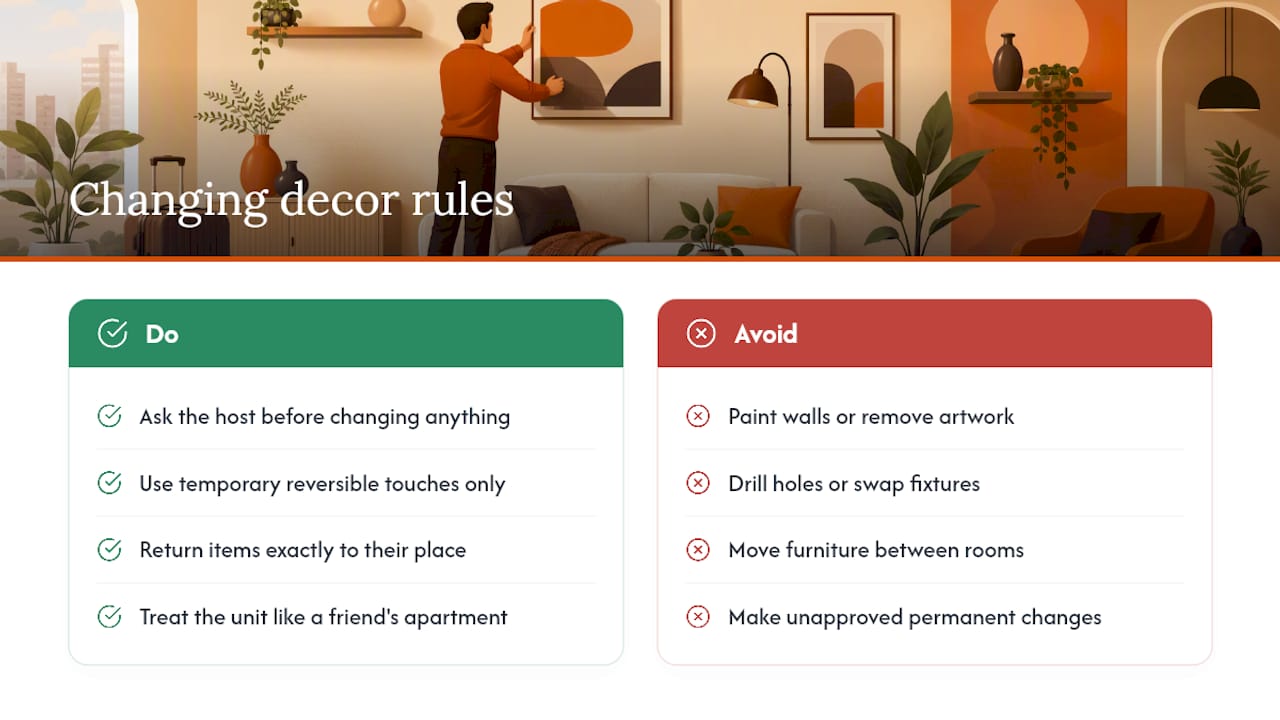
No, and this trips up more guests than you’d expect. Standard policy across furnished rentals bans permanent alterations: no painting walls, no removing artwork or furniture, no drilling holes for shelving or curtain rods, and no swapping out fixtures. Temporary, reversible touches, like a tablecloth or your own throw pillows, are usually fine as long as everything goes back exactly where it was.
The reason is simpler than it looks. These units are furnished specifically to photograph and rebook the same way for the next guest, so a host’s cleaning and turnover team relies on the space returning to baseline. Moving furniture between rooms, even temporarily, often gets flagged during the post-stay walkthrough and can trigger a reset fee if items aren’t put back.
If you need something changed for a real reason, a piece of furniture blocking a doorway, a mattress that doesn’t work for your back, message the host directly instead of just moving things. Most hosts will accommodate a reasonable request when you ask first; almost none will waive a fee for a change made without asking. Treat the unit the way you’d treat a friend’s apartment you’re borrowing for a few weeks, not a blank canvas.
What Happens in an Emergency During Your Stay?
Safety always overrides house rules, full stop. If there’s a fire, medical emergency, break-in, or gas smell, call 911 first and worry about notifying the host after you’re safe.
For non-life-threatening issues, most guidebooks list a specific order: text or call the host’s emergency line first, since property managers can usually resolve a lockout, a power outage, or a broken appliance faster than a general contractor can. If the host is unreachable and the issue affects safety (a broken lock, no heat in winter, a water leak), contact the building’s after-hours maintenance line if one is listed, or a local locksmith or plumber and keep the receipt for reimbursement.
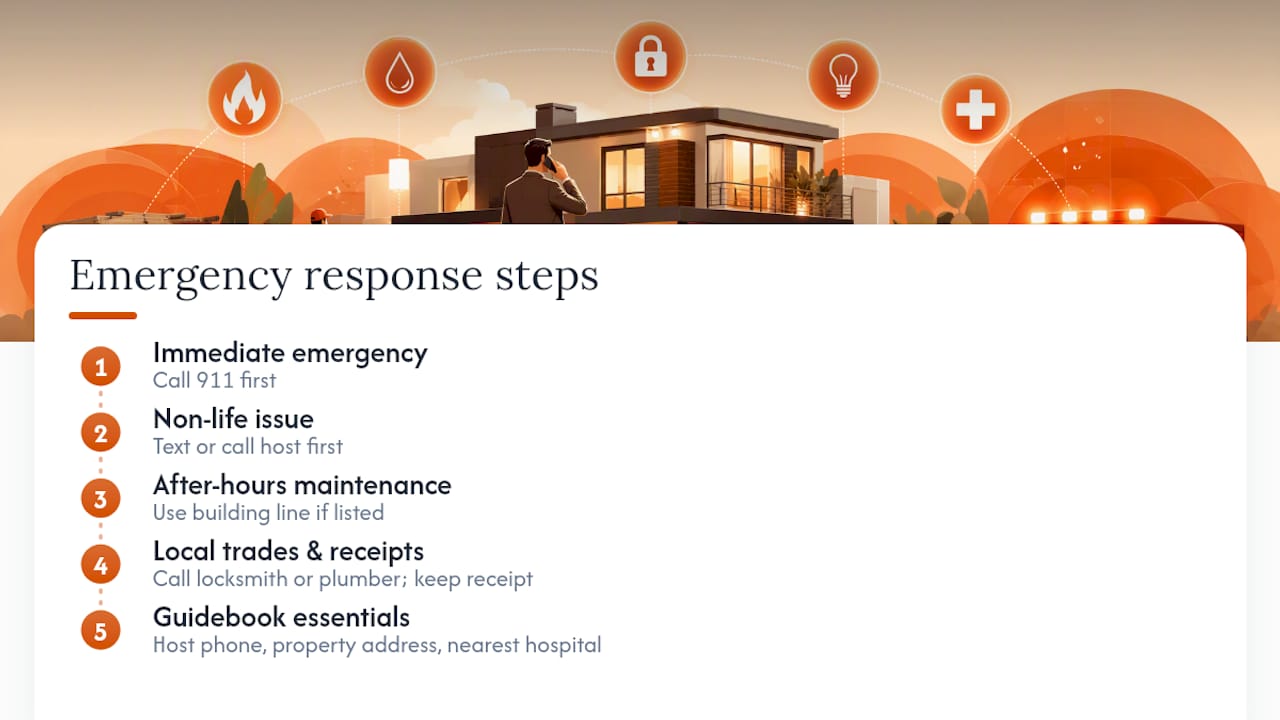
Every well-run guidebook should include, at minimum, the host’s phone number, the property address (guests forget this more often than you’d think when they’re panicked), and the nearest hospital or urgent care. If your unit’s guidebook is missing any of that, ask the host to send it before you arrive. That’s a reasonable, low-friction request that any responsive host should handle in minutes.
What Actually Happens When You Break a Rule?
Consequences scale with severity, and almost nobody gets evicted on a first offense for something minor. A single noise complaint usually gets you a warning message. A repeated one, or a party, or unauthorized long-term guests moving in, is what actually gets a reservation terminated mid-stay.
Financial consequences are more common than eviction. Indoor smoking, pet violations in a no-pet unit, or property damage typically result in a charge to the card on file, following the documentation process most hosts already use. Termination clauses exist in nearly every rental agreement and platform policy, but hosts generally reserve them for safety issues, illegal activity, or repeated violations after a warning, not a single loud evening.
If you’re facing termination, you’re entitled to see the specific rule you allegedly violated and the evidence behind it. That’s your cue to open a dispute through the platform’s resolution process rather than simply accepting the charge, especially if the rule in question wasn’t clearly disclosed at booking in the first place.
The Rules That Actually Protect You, Not Just the Host
Most advice on this topic treats house rules as a one-way street: things guests have to follow so hosts don’t lose money. That’s backwards. A clearly written rule with a specific consequence attached protects you too, because it tells you exactly what you’re agreeing to instead of leaving you guessing.
Guests who get hit with surprise charges are almost never the ones who broke an obvious rule. They’re the ones who never read past the listing photos, assumed “quiet hours” meant something vague, or trusted a verbal promise from a host that never made it into writing. If a rule isn’t specific enough to have a number attached to it, whether that’s a time, a fee, or a headcount, treat it as unenforceable and ask for clarification before you rely on it.
My honest read: the platforms standardizing rule categories is good for guests, not just hosts. It means you can learn the handful of categories that matter, occupancy, noise, smoking, pets, checkout, once, and recognize them instantly across almost any listing you book next.
— Sean
Ready to Book a Furnished Rental With Rules You Can Actually Trust?
Skipping the guesswork on house rules starts with picking a host who posts them plainly instead of burying them in a PDF nobody reads. Phoenix Furnished Rentals lists checkout times, occupancy limits, and pet policy directly on every property page, so you know what you’re agreeing to before you enter a card number, not after.
Browse current availability on the Phoenix Furnished Rentals landing page, or get a feel for how rules are presented in practice on the Sunset Casita property page. Corporate travelers relocating for work should also check out the corporate housing options in downtown Phoenix, which lay out flexible-lease terms alongside the same guest rules you’ll see on every listing. If anything about occupancy, pets, or parking isn’t clear on a property page, message the host directly before you book. That single question can save you a fee later.
Sources
- Airbnb House Rules: Template and Examples (2026)
- Ground rules for home guests
- Vacation Rental House Rules: What to Include 2026
- How to write vacation rental house rules that actually protect your property
FAQ
How Many House Rules Should a Rental Actually Have?
Most well-run listings cap it at 8 to 15 items, with many hosts trimming to 8 to 12 for better guest compliance and fewer disputes.
Can a Host Charge Me for a Rule I Wasn’t Told About?
Generally, no. Rules are only enforceable for deposit or damage claims if they were disclosed at booking or included in a signed agreement.
What Are the Five Most Important Rules to Check Before Booking?
The five that carry the most weight are no parties or events, no indoor smoking, no unregistered overnight guests, quiet hours, and the exact checkout time.
What Should I Do If a Host Charges Me Unfairly?
Gather your message thread and any photos, then request an itemized invoice or open a Resolution Center claim with the platform rather than disputing it verbally.
Does Phoenix Furnished Rentals Post House Rules Before I Book?
Yes. Rules appear on the listing page and again in the pre-arrival message, and refund or cancellation terms are published separately so you can review everything before paying.
Leave a Reply